


 Silicones, silicone oils, sprays
 Casting and potting resins
)
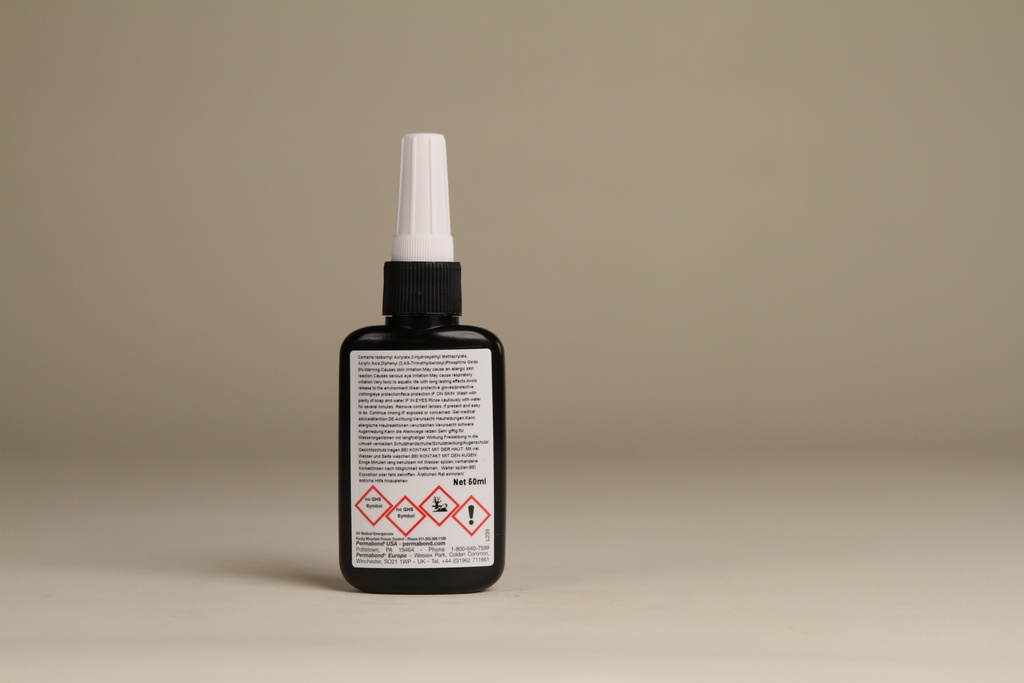
)
PERMABOND UV670
1K UV-curing adhesive (methacrylic acid ester), colorless, cured flexible and very impact-resistant; for glass to metal and metallized plastics.
Viscosity 2,000–3,000 mPa·s · Curing time 365–400 nm: 7 s at 4 mW/cm² · Shore D 50–60
Flexible, impact-resistant UV adhesive — for dynamically stressed glass-to-metal bonding.
Documents
HS Code:
3506.9190000
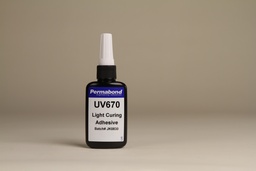
Permabond UV670 is a flexible, impact-resistant, UV-curing adhesive — designed for dynamically stressed glass-to-metal bonding and metallized plastics, with low hardness and high impact resistance.
With a Shore D hardness of 50–60, UV670 is more flexible than standard UV adhesives in the 600 series (60–75 Shore D). This flexibility buffers thermal expansion and contraction between glass and metal—important for components subject to temperature fluctuations.
The high impact strength (>80% elongation at break) and the medium viscosity of 2,000–3,000 mPa·s make UV670 a robust choice for industrial applications — even metallized plastic components can be reliably bonded.
Flexible, impact-resistant UV adhesive — its lower hardness (50–60 Shore D) makes UV670 the first choice for dynamically or thermally stressed glass-to-metal bonding. Also suitable for metallized plastics.
What makes Permabond UV670 stand out
What is Permabond UV670 used for?
Processing
Recommended accessories
Important Notes
Which Permabond UV adhesive for which application?
Permabond UV670 in direct comparison with related products of the UV series.
Permabond UV670 Current Product | Permabond UV620 → | Permabond UV675 → | Permabond UV625 → | |
|---|---|---|---|---|
| Application | Flexible, impact-resistant UV adhesive for glass-metal | Harder, visually clearer | Low viscosity clear | Vertical Application |
| Viscosity | 2,000–3,000 mPa·s @ 20 rpm | 2,200–2,900 mPa·s | 500–800 mPa·s | Gel |
| Substrate Strength | 6–10 N/mm² | 9–10 N/mm² | 8–12 N/mm² | 6–10 N/mm² |
| Elongation at break | >80 % | >80 % | >50 % | >60 % |
Technical data for PERMABOND UV670
| Product Information | |
|---|---|
| Manufacturer | Permabond Engineering Adhesives Ltd |
| Brand | Permabond |
| Container | 50 ml, 1 l |
| Country of origin | Italy |
| Performance at Full Cure | |
|---|---|
| Tensile strength (ISO37) | 12 N/mm² |
| Refractive index | >1,490 |
| Elongation at break (elasticity) (ISO37) | >80% |
| Dielectric Strength | 12 KV/mm |
| Dielectric constant 1MHz at 25°C | 4 |
| Water absorption (ISO62) 2 hrs in boiling water | <2.5% |
| Tensile strength (ASTM D-2095-69) glass/steel | 6-10 N/mm² |
| Physical Properties | |
|---|---|
| Color | colorless |
| Chemical group | Methacrylate ester |
| Viscosity (adhesives) | Medium viscosity 500 - 5000 mPas |
| Viscosity at 20 rpm | 2000-3000 |
| Specific Gravity | 1.1 |
| Curing values | |
|---|---|
| Curing Wavelength | 365 - 420 nm |
| Mechanical properties | |
|---|---|
| Hardness (Shore D) | 50-60 |
| Thermal Properties | |
|---|---|
| Storage Temperature (°C) | 5-25 |
Please refer to the technical data sheet (TDS) in the "Documents" tab for binding values.
Documents and data sheets
Click on a document for the preview or the download icon for direct download.
Technical Data Sheets (TDS) 3
Frequently asked questions about Permabond UV670
Practical application and design questions — answered by SILITECH.
Permabond UV670 is a methacrylic acid ester (UV-curing) adhesive with a viscosity of 2,000–3,000 mPa·s @ 20 rpm. It is a flexible, impact-resistant UV adhesive for glass-to-metal bonding—including metallized plastics. The adhesive cures upon irradiation with UV light in the spectral range of 365–400 nm—curing in seconds "on demand".
Permabond UV670 cures in the spectral range of 365–400 nm. Standard mercury vapor UV lamps, LED UV lamps with a suitable wavelength, or UV light guide systems are all suitable. For LED lamps, the maximum wavelength of the LED must be matched to the curing spectrum of the adhesive—we are happy to advise you on selecting the right lamp.
Permabond UV670 typically cures in: 7 s with a 4 mW/cm² low-power lamp; 2 s with a 100 mW/cm² LED lamp; 1 s with a 30 W/cm² UV light guide system. The exact curing time depends on the layer thickness and the light transmittance of the components.
Permabond UV670 bonds reliably to glass/steel: 6–10 N/mm². For thermoplastic substrates, we recommend testing compatibility before series production — release agents on injection-molded parts can impair adhesion.
Permabond UV670 is a flexible, impact-resistant UV adhesive for glass-to-metal bonding (2,000–3,000 mPa·s @ 20 rpm viscosity, >80% elongation at break). Permabond UV620 is an optically clear (2,200–2,900 mPa·s, >80% elongation at break) hardener.
When stored at 5 to 25 °C and protected from light, Permabond UV670 is stable until the printed expiration date. IMPORTANT: UV adhesives cure upon contact with light — always store the bottle in the dark and only open it briefly under UV-blocked light. Daylight-stable variants (e.g., UV675) can be used briefly under ambient light.
From the Permabond UV range, select according to substrate, viscosity, and special properties: Permabond UV670 (flexible, impact-resistant UV adhesive for glass-to-metal); Permabond UV620 (optically clear); Permabond UV675 (crystal clear); Permabond UV625 (thixotropic gel). For shadowed areas (where UV light does not fully reach the adhesive gap), a dual-cure variant such as Permabond UV7141 (UV + anaerobic) should be used.
Your question not covered?
Our technical team provides personal advice on material selection, processing questions, and individual requirements. Fast and competent.
Product Specifications
| Product Information | |
|---|---|
| Container | 50 ml or 1 l |
| Manufacturer | Permabond Engineering Adhesives Ltd |
| Brand | Permabond |
| Country of origin | Italy |
| Performance at Full Cure | |
|---|---|
| Tensile strength (ISO37) | 12 N/mm² |
| Refractive index | >1,490 |
| Elongation at break (elasticity) (ISO37) | >80% |
| Dielectric Strength | 12 KV/mm |
| Dielectric constant 1MHz at 25°C | 4 |
| Water absorption (ISO62) 2 hrs in boiling water | <2.5% |
| Tensile strength (ASTM D-2095-69) glass/steel | 6-10 N/mm² |
| Physical Properties | |
|---|---|
| Color | colorless |
| Chemical group | Methacrylate ester |
| Viscosity (adhesives) | Medium viscosity 500 - 5000 mPas |
| Viscosity at 20 rpm | 2000-3000 |
| Specific Gravity | 1.1 |
| Curing values | |
|---|---|
| Curing Wavelength | 365 - 420 nm |
| Mechanical properties | |
|---|---|
| Hardness (Shore D) | 50-60 |
| Thermal Properties | |
|---|---|
| Storage Temperature (°C) | 5-25 |
| Keywords | |
|---|---|
| Keywords | |
Documents and data sheets
Safety Data Sheets (SDS) and Technical Data Sheets (TDS) for download:
- Permabond UV670 - Technical Data Sheet FR.pdf (282 KB)
- Permabond UV670 - Fiche de Sécurité FR.pdf (501 KB)
- Permabond UV670 - Safety Data Sheet EN.pdf (480 KB)
- Permabond UV670 - Safety Data Sheet DE.pdf (502 KB)
- Permabond UV670 - Technical Data Sheet EN.pdf (318 KB)
- Permabond UV670 - Technical Data Sheet DE.pdf (309 KB)