


 Silicones, silicone oils, sprays
 Casting and potting resins
)
BLUESIL RTV 141 B (2.5 kg)
Part B of the transparent RTV-2 investment compound RTV 141 (addition); with Part A, 100 parts A : 10 parts B; for electronic components and devices
Shore A 50 · Viscosity of mixture 4,000 mPa·s · Pot life 4 h at 25 °C
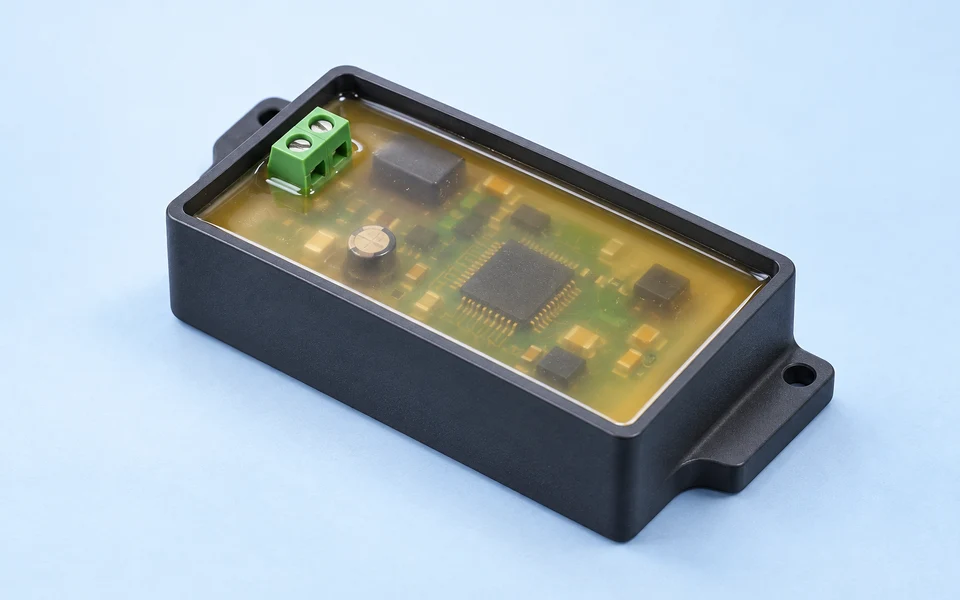
Transparent, optically clear 2K-Pt silicone potting compound (Shore A 50) for embedding electronic components, optical fibers and barrier photocells
Documents
Internal reference:
40-901.KE.K2.5
HS code:
39100000

BLUESIL RTV 141 A&B E5 is a two-component, addition-curing RTV-2 silicone that cures at room temperature to a transparent elastomer and is used for potting and protecting electronic and optoelectronic components.
After mixing the two components, BLUESIL RTV 141 A&B E5 forms a relatively low-viscosity, colorless liquid that cures into an elastic, transparent material. The reaction does not release heat, and curing can be accelerated by heating.
Addition-curing RTV-2 silicone with good optical transmission and good pourability, designed for the protection and insulation of light-sensitive and optoelectronic components.
What sets RTV 141 apart
What is RTV 141 used for?
Processing
Important Notes
- Curing may be inhibited by contact with sulfur-containing rubbers, metal salt-catalyzed RTV, tin-stabilized PVC, or amine-cured epoxies; if in doubt, test beforehand.
- Curing at room temperature results in low linear shrinkage (approx. 0.4%), but prevents the vulcanizate from achieving its optimal mechanical properties.
- The currently valid Elkem data sheet (TDS and SDS) is authoritative, which we will be happy to send you.
Technical data for BLUESIL RTV 141 B (2.5 kg)
| Product Information | |
|---|---|
| Brand | Bluesil |
| Manufacturer | Elkem Silicones |
| Curing type | Addition (Platinum) |
| Number of components | 2K (two-component) |
| Consistency | Flowable |
| Mixing Ratio | 10:1 |
| Further Properties | |
|---|---|
| UV resistance | No |
| Physical Properties | |
|---|---|
| Cured Color | Transparent |
| Self-leveling | Yes |
| Uncrosslinked viscosity (mPa·s) | 30 |
| Electrical Properties | |
|---|---|
| Electrical Insulation | Yes |
| Curing values | |
|---|---|
| Pot life (min) | 3 |
| Demolding time (min) | 15 |
| Product Approvals | |
|---|---|
| Food contact | No |
| Medical grade | No |
| Mechanical properties | |
|---|---|
| Tensile strength (MPa) | 4 |
| Elongation at break (%) | 500 |
| Tear strength (N/mm) | 15 |
Please refer to the technical data sheet (TDS) in the "Documents" tab for binding values.
Documents and data sheets
Click on a document for the preview or the download icon for direct download.
Technical Data Sheets (TDS) 3
Frequently Asked Questions about RTV 141
Practical application and design questions, answered by SILITECH.
100 parts RTV 141 A E5 to 10 parts RTV 141 B E5 (parts).
The pot life of the catalyzed mixture is approx. 4 h at 25 °C.
Yes, degassing at 30 to 50 mbar is recommended to avoid air bubbles; the product must be degassed for a particularly long time.
Adhesion is achieved on most substrates with the primer PRIM PMB 821; the potting should be carried out within four hours after the primer has dried.
Your question not covered?
Our technical team provides personal advice on material selection, processing questions, and individual requirements. Fast and competent.
Product Specifications
| Product Information | |
|---|---|
| Brand | Bluesil |
| Manufacturer | Elkem Silicones |
| Curing type | Addition (Platinum) |
| Number of components | 2K (two-component) |
| Consistency | Flowable |
| Mixing Ratio | 10:1 |
| Further Properties | |
|---|---|
| UV resistance | No |
| Physical Properties | |
|---|---|
| Cured Color | Transparent |
| Self-leveling | Yes |
| Uncrosslinked viscosity (mPa·s) | 30 |
| Electrical Properties | |
|---|---|
| Electrical Insulation | Yes |
| Curing values | |
|---|---|
| Pot life (min) | 3 |
| Demolding time (min) | 15 |
| Product Approvals | |
|---|---|
| Food contact | No |
| Medical grade | No |
| Mechanical properties | |
|---|---|
| Tensile strength (MPa) | 4 |
| Elongation at break (%) | 500 |
| Tear strength (N/mm) | 15 |
| Keywords | |
|---|---|
| Keywords | |
| Mechanical properties | |
|---|---|
| Shore hardness A | 50.0 Shore A |
| Tensile Strength | 6.0 MPa |
| Elongation at break | 120.0 % |
| Linear shrinkage | < 1.2 % |
| Processing | |
|---|---|
| Viscosity of Mixture | 4,000 mPa·s |
| Viscosity Comp. A | 3'500 mPa·s |
| Viscosity Component B | 650 mPa·s |
| Pot life at 23°C | 240.0 min |
| Demolding time | 2160.0 min |
| Physical & Thermal | |
|---|---|
| Density (23°C) | 1.02 g/cm³ |
| Refractive index n (20°C) | 1.406 |
| Temperature Resistance (Continuous) | -70 to 200 °C |
| Peak Temperature (Short-term) | 200 °C |
| Thermal conductivity | 0.16 W/(m·K) |
| Electrical characteristics | |
|---|---|
| Dielectric constant ε (1 kHz) | 2.7 |
| Dielectric strength | 20.0 kV/mm |
| Volume resistivity | 1e+15 Ω·cm |
| Dissipation factor tan δ | 0.001 |
| Storage | |
|---|---|
| Shelf life in original packaging | 24 months |
| Storage Temperature | -5 to 30 °C |
Documents and data sheets
Safety Data Sheets (SDS) and Technical Data Sheets (TDS) for download:
- Bluesil RTV 141 B E5 - Fiche Technique FR.pdf (205 KB)
- Bluesil RTV 141 B E5 - Fiche de Sécurité FR.pdf (498 KB)
- Bluesil RTV 141 B E5 - Scheda di Sicurezza IT.pdf (491 KB)
- Bluesil RTV 141 B E5 - Safety Data Sheet DE.pdf (294 KB)
- Bluesil RTV 141 B E5 - Technical Data Sheet EN.pdf (547 KB)
- Bluesil RTV 141 B E5 - Technical Data Sheet DE.pdf (197 KB)