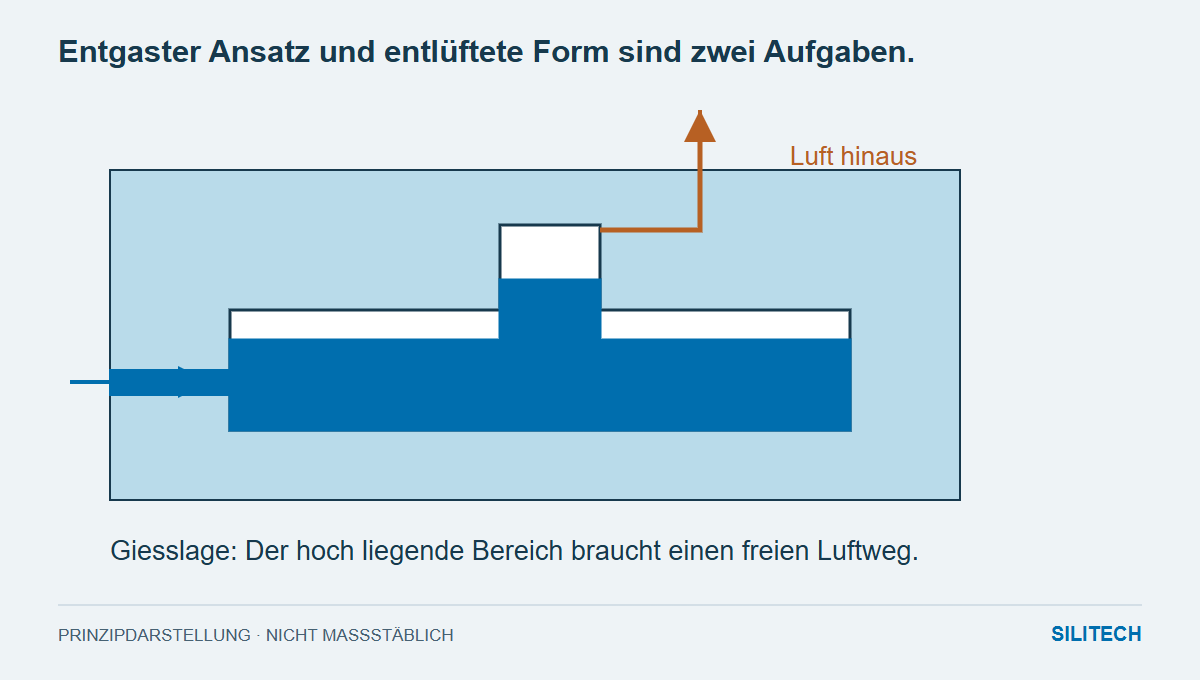
Three casts, the same flaw: A small pin is incomplete at the tip. The rest of the body is cleanly formed. Further degassing would be an obvious reaction. However, this is ineffective if the air is then trapped within the mold.
Before pouring, air is present in the cavity. The incoming material must displace it. If a high-lying pocket has no open path to the outside, some residue can remain there – even if the mixture was carefully degassed beforehand.
Two air problems, two work processes
Air introduced during mixing is treated within the material, for example, by a vacuum degassing system. The air in the mold cavity is treated by filling and venting. A good result in the first step does not guarantee a good result in the second.
The Elkem instructions for BLUESIL RTV 3428 cover the removal of any air incorporated into the casting before pouring. The geometry of the final mold must also be considered for the component. Both planes should remain distinguishable if bubbles are found.
The drawing must show the casting position
The pin can point downwards in the installed component and still form the highest point during casting. A sketch in the working position will then lead you astray.
In the casting diagram, two paths are shown: one for material in, one for air out. The point at which the material front closes off a section is of particular interest. If a cavity without ventilation remains above this point, the trapped air cannot simply escape through the material that has already flowed in.
The support shape and clamping mechanism should also be included in the sketch. An opening visible on the free silicone half may be concealed in the closed assembly. The crucial factor is the complete state during filling.
A minor procedure with a clear expectation
For example, in the case of a repeatedly missing tap, the working hypothesis is: The upper cavity does not have a sufficient air passage. Any changes to the ventilation or pouring position are then specifically compared with the previous process.
The result isn't simply "better" or "worse." Is the tip now complete? Is the defect migrating? Is a new air pocket forming elsewhere? These observations reveal whether the change is consistent with the suspected filling problem.
The venting point remains visible on the part
An additional channel also provides a possible route for casting material to escape. Its insertion point must be located where rework is permissible and accessible. Otherwise, proper venting at a future sealing or visible surface could create a new problem.
The material inquiry becomes more precise when it includes two views: the defect on the casting and the closed mold in the casting position. This allows the air path to be traced, instead of treating every incomplete detail as a general degassing defect.
Two practical questions
Is a consistently identical defect definitely a ventilation problem?
No. Repetition makes a geometric cause worth investigating, but it doesn't prove it. Filling behavior, material condition, and other reproducible influences still need to be considered in comparison.
Does the ventilation duct need to be as large as possible?
The location and connection to the enclosed area are the primary considerations. The design also takes into account filling behavior, material leakage, and permissible rework.
To deepen the connection
Technical Sources and Conditions
The current product documentation is decisive for processing.