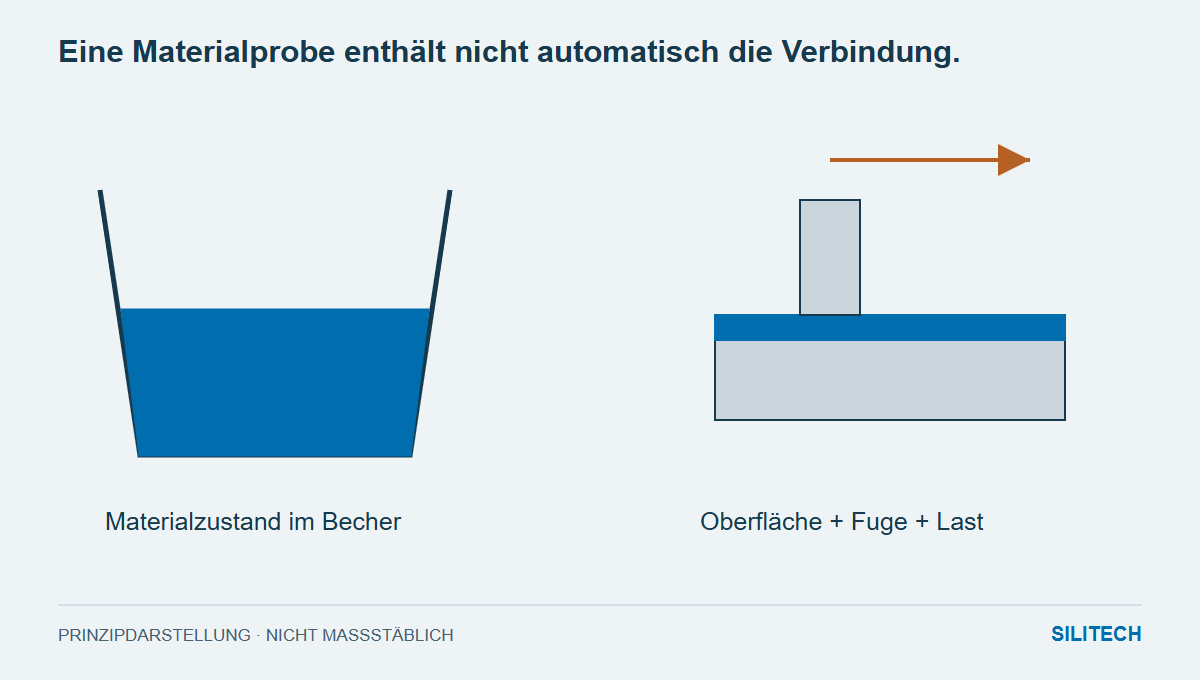
The adhesive residue in the cup is hard. Nevertheless, the bond on the component fails. This seems contradictory as long as the cup residue is considered a miniature version of the adhesive bond.
That's precisely what it isn't. It's in contact with a different substrate, has a different geometry, and may have had a different temperature profile. The hardness of the remaining material and its adhesion to the component are different test results.
What the cup is missing
Let's take an aluminum holder with a thin adhesive joint. Its function depends, among other things, on the prepared surface, the wetting, and the load path. None of these are automatically present in the remaining material.
The remaining results can therefore provide an indication of the approach, but cannot prove adhesion to the aluminum. The National Physical Laboratory, in its testing guidelines, accordingly distinguishes between material tests and tests on compounds. The method is chosen according to the question it is intended to answer.
The curing conditions can also differ
A compact residue and a thin joint conduct heat differently. In exothermic systems, the reaction itself can generate heat; its course depends, among other things, on the quantity and geometry of the reaction. Therefore, the same time of day does not necessarily mean the same temperature history.
This difference is another reason not to treat random cup remnants like standardized test specimens. A deliberately produced material sample with a defined purpose is something different from what remains after assembly.
Three samples, three meaningful tasks
A retained residual quantity provides material for possible later analysis. A defined material sample serves a specific measurement. A bonded sample contains the relevant surfaces and the intended geometry or load.
The samples complement each other if they are clearly assigned to the same process. Without this assignment, a hard residue from a different mixing process can even steer the investigation of the cause in the wrong direction.
The rehearsal begins with her question
If the first mixture after a break is to be evaluated, the sample must come precisely from that initial batch. A residue from the end of the preparation answers a different question. If multiple phases are collected, the temporal information is lost.
For recurring material testing, the shape, quantity, sampling time, and curing conditions are defined to suit the process. For the holder, a connection test is added. Only this test takes into account the actual surface structure and the required load transfer.
The precise statement is therefore: "This sample has reached this state under these conditions." It is useful precisely because it makes no further claims. The question regarding the adhesive bond remains open, a question that only the appropriate bond can answer.
Two practical questions
Are retained samples even useful then?
Yes. You can obtain material for later investigations and, if the approach is clearly assigned, document it. Its usefulness depends on the defined purpose.
Can I compare two cup residues by pressing them together?
This provides a subjective impression. A suitable method and comparable sample conditions are needed for a reliable property test.
To deepen the connection
Technical Sources and Conditions
The current product documentation is decisive for processing.