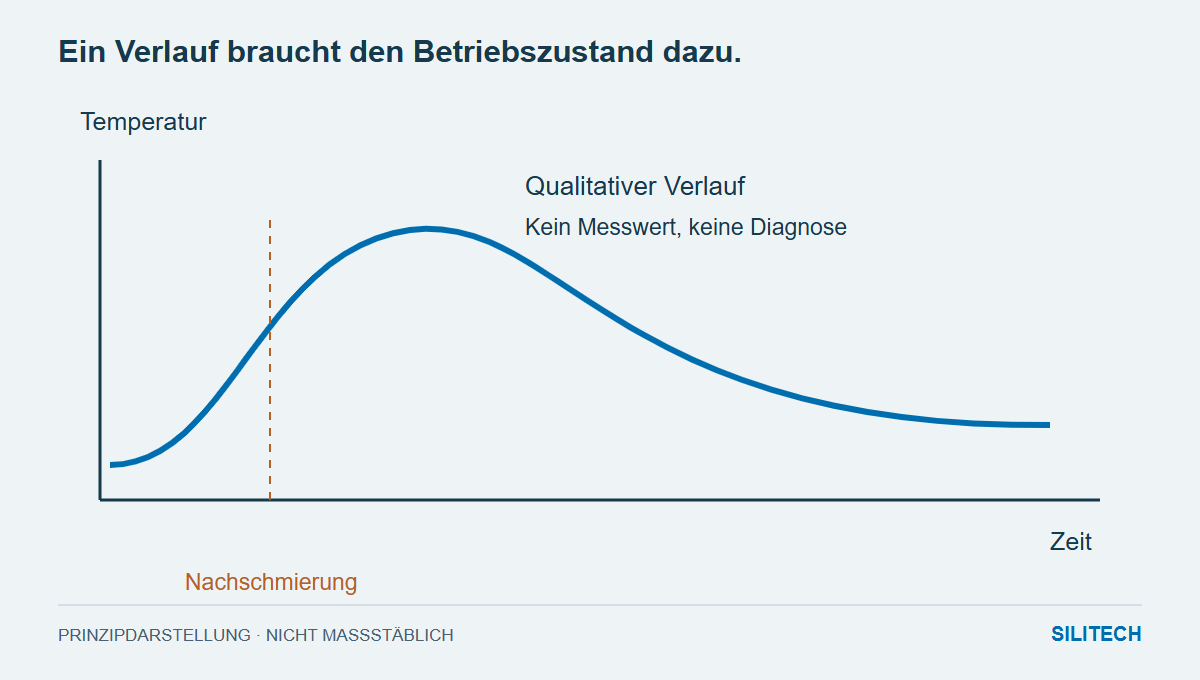
Before maintenance, the bearing runs smoothly. After relubrication, the temperature rises. Applying another stroke would now be an intuitive but unexplained reaction: additional lubricant could actually exacerbate the suspected problem.
Grease does not reduce friction, regardless of its quantity and distribution. After filling, material initially resides in areas traversed by the rolling elements. This material must be moved and displaced. This work causes losses.
From walking to reservoir
SKF describes a flexing phase after initial filling or relubrication. During this phase, grease is forced into less frequently lubricated areas of the bearing. From there, the raceways are subsequently supplied with lubricant.
Excessive grease can prolong the period of increased losses. The potential temperature rise is therefore technically explainable. However, this does not constitute a diagnosis of a specific bearing or a general recommendation to simply continue operating it. The system's alarm and maintenance limits remain in effect.
The trend is more meaningful than a single value
To determine the cause, the relubrication is linked to the conditions prior to the problem: measurement location, rotational speed, load, and ambient conditions. This is followed by an analysis of the quantity supplied and the temperature profile over time.
If the machine load increases simultaneously, the change cannot be attributed solely to the grease. If measurements are taken at a different location after maintenance, the measurement point itself can produce a difference. Comparability is achieved through the same reference point, not simply by the same number on a display.
Ten strokes are only a lot if the output is known
A different press or a changed conveying condition can deliver a different quantity per stroke. Therefore, for clarification, it is important to know how much was actually fed in and what route is designated for excess material according to maintenance specifications.
A free outlet and a closed space are different situations. Therefore, any correction of the fill is carried out according to the appropriate maintenance procedure; additional injection is not a general solution.
A plausible explanation remains a hypothesis
Temperature alone is not sufficient to reliably distinguish between overfilling, contamination, mechanical problems, and other causes. Noise and vibration patterns, as well as other findings, can help narrow down the investigation. A subsequent drop in temperature is also a finding, but not conclusive proof of the cause.
For the next maintenance check, the advantage often lies in a better starting point: known quantity, defined measurement location, and comparable operation. This transforms "warmer after lubrication" into a trend that can be technically assessed.
Two practical questions
Should I let it continue running if the temperature rises, until the grease has distributed itself?
This depends on the system's operating, alarm, and maintenance specifications. The explanation of the walk phase does not replace these limitations.
Does a subsequent drop in temperature prove overfilling?
No. It is compatible with various changes in the system. Quantity, operating state, and other findings must be considered together.
To deepen the connection
Technical Sources and Conditions
The current product documentation is decisive for processing.