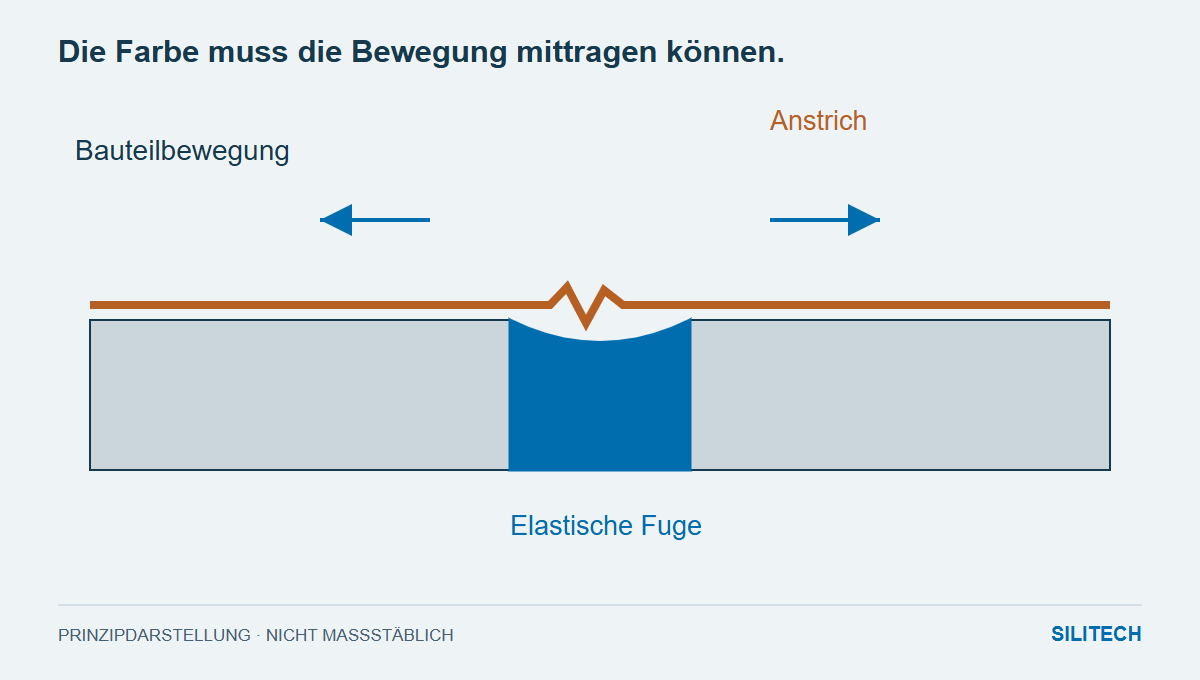
Two painted panels are sealed with an elastic sealant. Finally, a coat of paint will be applied over everything. The sealant's data sheet states it is "paintable" – so the matter seems settled.
The term alone, however, does not answer which contact scenario is meant. A sealant applied over existing paint, a coat of paint next to the joint, and a layer of paint covering the entire joint each have different requirements.
The order determines the interface
merz+benteli distinguishes these cases in its information sheet as A1, A2 and A3. In the first case, sealing is done on top of an existing coating, in the second case a subsequent coat of paint borders it, and in the third case the sealant is painted over.
For this inquiry, a cross-section is often clearer than the word "paintable." It shows which layer is present first and where the next one is located. Good adhesion of the sealant to the paint is not an automatic guarantee that the paint will adhere well to the sealant.
The paint layer accommodates the movement of the joint
When a paint layer is applied completely over an area that is meant to be elastically deformable. If the paint cannot accommodate this stretching, it can crack, even if it initially adheres well.
The technical data sheet for Merbenit ST40 therefore sets a clear limit: Movement-absorbing sealants must not be painted over completely if their elongation is greater than that of the paint. A smooth paint patch on a stationary sample does not adequately test this load.
Color itself is a material system
Terms like "water-based" or "synthetic resin paint" are often too vague for a direct comparison. Primer, topcoat, drying, and substrate form a layered sequence. The ST40 data sheet, for example, mentions possible drying delays with alkyd resin paints.
A sensible sample setup therefore includes the products actually intended and the joint. The initial assessment of the surface and its behavior under the intended movement address various aspects of the task.
A visible joint can be deliberately designed
If the combination doesn't allow for complete coverage, the coating boundary is defined early on. A suitable grout color or a deliberately visible transition can shape the structure without subjecting the paint to an unsuitable movement requirement.
This decision must be made before execution. The subsequent requirement for a visually continuous surface should not inadvertently become an additional technical specification for a sealant that has already been selected.
To clarify the situation, the exact color, the sealant, and a sketch of the layers including the expected joint movement are helpful. This allows the contact situation to be identified first – and then the appropriate design to be determined.
Two practical questions
Is an adhering paint stain sufficient proof that a joint has been painted over?
He first demonstrates the adhesion or compatibility on this sample. The movement of the actual joint and the entire paint structure must also be taken into account.
What is the alternative to a complete recoating?
A defined coating boundary or a suitable joint color can be part of the design. The specific solution must fit the construction and available materials.
Mentioned in the article
Merbenit ST40 ↗To deepen the connection
Technical Sources and Conditions
The current product documentation is decisive for processing.