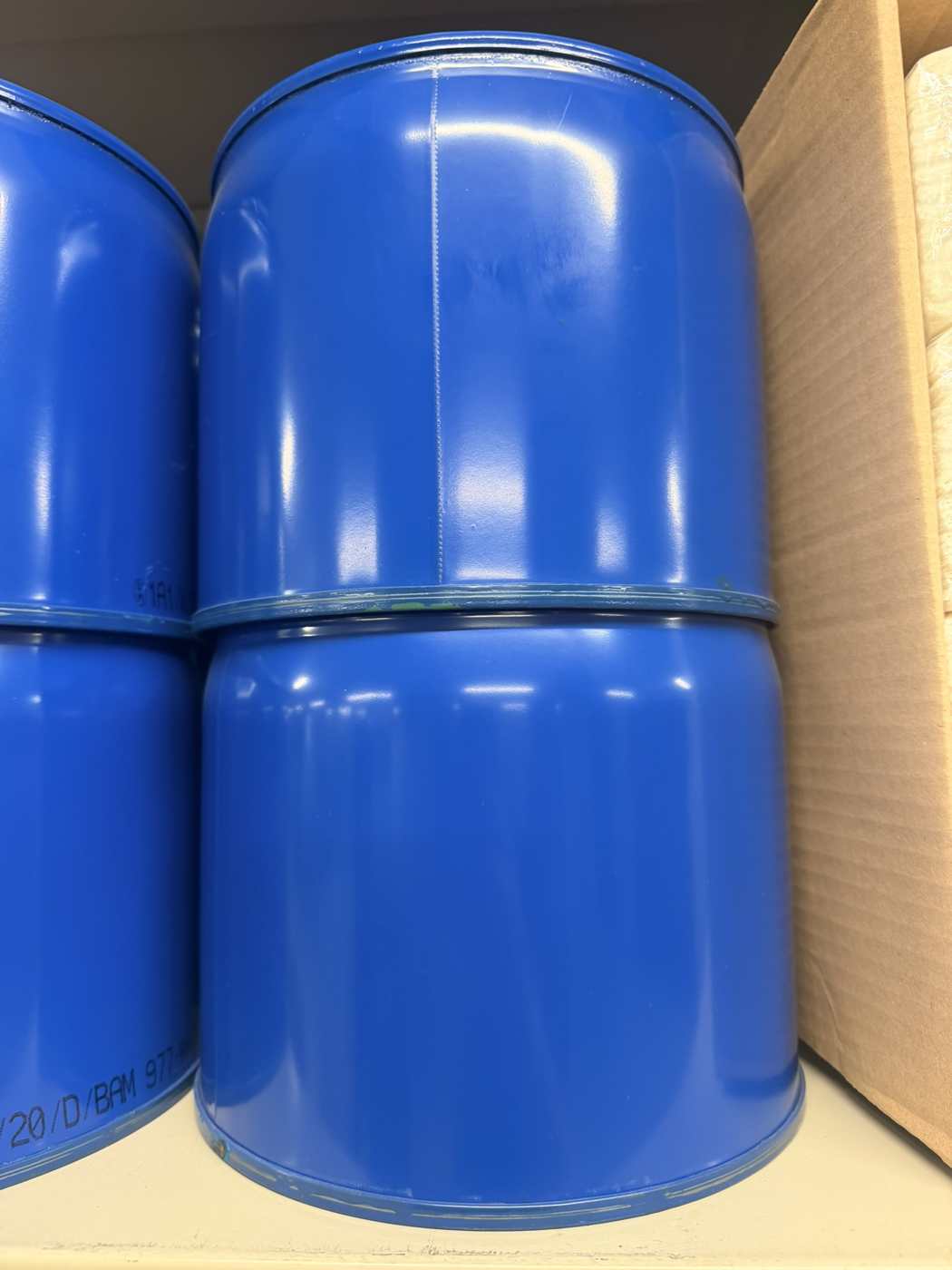
A material is intended to resist moisture later on. This does not mean that its components are insensitive to moisture in an open container. The material's condition changes fundamentally between storage and use.
The data sheet often describes these conditions in different sections: storage conditions for the product in its container, processing of the components, and properties of the cured material. Copying a statement from one section to another can lead to incorrect work instructions.
The reaction is precisely the reason for the distinction
Resin and hardener are prepared in such a way that they react under the specified conditions and form the desired material. The final properties are inherent to the manufactured state. The individual components have a different composition and must be treated according to their own specifications.
"Water-resistant" also needs to be defined: what material, what test, what temperature and what duration? It does not automatically mean vapor-tight, unchanged under all conditions, or suitable for any media.
The journey between two withdrawals is part of the processing
Let's consider a company that only needs small quantities from larger containers. The time between batches can be longer than the actual potting process. The closure, suitable dispensing aids, and storage location then influence the traceable material history.
The manufacturer's instructions for the specific combination determine this procedure. For example, Elkem specifies storage in the original packaging for BLUESIL RTV 141 A & B and refers to the storage information and expiration date on the container. These instructions apply to the delivered goods; a successfully cured test specimen does not invalidate them.
Bubbles alone do not identify the influence of moisture
If bubbles appear during the later stages of the process, several factors in the sequence are possible: mixing, transferring, filling, and potentially chemical processes within the system in question. Appearance alone does not differentiate them.
Therefore, an observed bearing deviation is identified as such, without immediately deducing the entire cause. A comparison with clearly prepared components can narrow down the investigation. However, unauthorized heating or the addition of extra hardener alters the initial conditions and can introduce further influences.
The correct section of the datasheet answers the correct question
For the finished component, durability and function are considered. Storage and dispensing guidelines apply to the opened container. For the batch, the formulation and processing apply. All three belong to the same application but are not interchangeable.
When the storage history is unknown, the uncertainty is clarified by the precise product and batch identification. This is a more precise starting point than concluding that the material must still be good because the subsequent plastic is moisture-resistant.
Two practical questions
Does a good result in the cup eliminate the storage limit?
No. The beaker shows the result of this test. The specifications for packaging, shelf life, and processing remain separate.
What information is helpful when a container has been open for an extended period?
Product, component pair, batch, first opening, and known storage and dispensing procedures. Unknown sections are explicitly treated as unknown.
Mentioned in the article
BLUESIL RTV 141 A + B (1.1 kg kit) ↗To deepen the connection
Technical Sources and Conditions
The current product documentation is decisive for processing.