The casting comes out of the mold easily. The edges are clean, and the surface looks good. A problem only becomes apparent during painting: the paint pulls back in places or doesn't adhere sufficiently later.
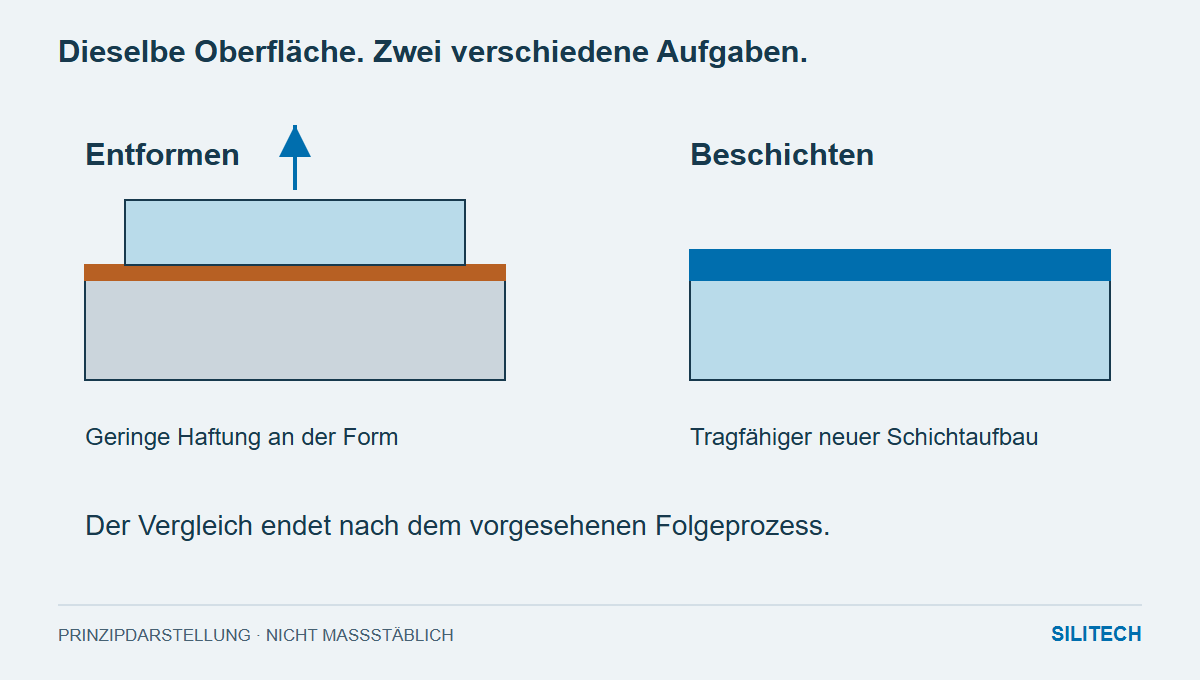
Demolding and coating place different demands on an interface. The release agent is intended to reduce the adhesion between the mold and the casting material. The subsequent coating, on the other hand, requires a surface that it can sufficiently wet and on which its layer structure can adhere.
The separating effect does not automatically end at the mold edge
Elkem describes release agents as thin films that reduce adhesion and facilitate sliding during demolding. Therefore, for a painted casting, it is relevant what residues remain on the part and how they are treated in subsequent processes.
A beautiful surface immediately after demolding does not answer this question. Likewise, the label "silicone-free" is insufficient: it describes a formulation property, not a successful paint adhesion test with the subsequent paint.
The better attempt extends to the complete layer structure
Let's take a housing component that is cleaned, primed, and painted after casting. A release agent candidate must enable this entire process. The evaluation therefore yields two results: How easily does the component detach – and how does the coating behave after the intended preparation?
It's worth taking a close look at the application of the release agent. A thin, even film and a repeatedly reapplied, uneven application represent different starting points. The first successful demolding alone does not guarantee the subsequent production run.
Cleaning is part of the material selection process
Preparation must remove any residues or create the intended coatable condition without damaging the casting. A solvent that visibly removes a film can simultaneously attack the plastic. Therefore, the choice depends on the release agent, casting material, and coating system combined.
Intermediate storage is also part of the process. A sample that is cleaned and painted immediately after demolding may bypass the transport crate and the production shift change. A subsequent defect then might not be solely attributable to the release agent.
Identify the error at the correct location
If an anomaly is detected, the release agent, cleaner, and primer are not changed simultaneously. First, the established procedure is compared with the deviation. Then, a targeted comparison can be set up, for example, using the same casting and two planned cleaning methods.
The goal is a consistent solution: reproducible demolding followed by the application of the required paint system. The cheapest release agent application can be the wrong one economically if it creates additional work or scrap at the painting station.
Two practical questions
Does a crater-shaped paint defect indicate the presence of a release agent residue?
No. The appearance directs the investigation to wetting and surface, but does not alone identify the causative agent. Handling and other contaminants must also be considered in the process comparison.
Why include further demolding processes in the comparison?
The condition after repeated use and refreshing may differ from the initial application. The trial should reflect the intended conditions of the subsequent process.
To deepen the connection
Technical Sources and Conditions
The current product documentation is decisive for processing.