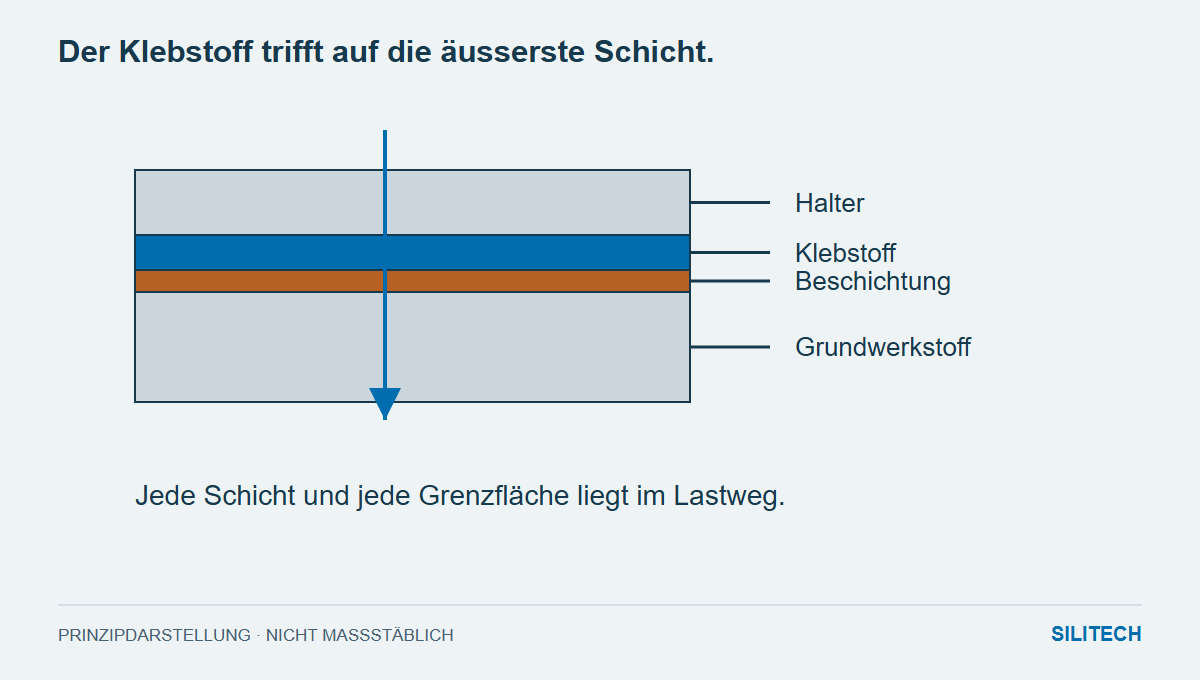
The drawing specifies aluminum. The sample consists of bare sheet metal. The final housing will be powder-coated. Although the base material remains the same, the sample examines a different bonding point.
The adhesive cannot penetrate an intact coating and reach the aluminum. It initially bonds to the coating's surface. This creates additional interfaces – and further potential points of separation – between the adhesive and the supporting metal.
The surface is part of the parts list for the adhesive bonding
Consider a painted cover that is to be attached to a steel angle bracket. The structure consists of: steel surface, adhesive, powder coating, and aluminum. Load transfer must function correctly for each of these layers. An adhesive with good adhesion to the paint will not compensate for a weak bond between the paint and the aluminum.
This also explains why the result on a bare scrap piece cannot be transferred to the finished housing. The test completely omitted the coating. Similarly, a hand-sanded production part would constitute a separate process variant: now both the surface and an additional processing step are evaluated.
The first attempt should only bear one decision
The initial question, for example, is whether a specific pretreatment improves adhesion to the intended powder coating. Representative coated samples are suitable for this purpose. The adhesive, curing process, and stress test remain the same; only the pretreatment is modified.
Only once this question is answered is a full holder test worthwhile. This involves considering factors such as lever arm, adhesive joint thickness, positioning, and accessibility for cleaning. Therefore, a small surface sample and a component sample serve different purposes. One allows for quicker comparison, while the other represents the entire design.
This results in a useful distinction for purchasing: A sample is a quantity of material. Sampling is a trial with a decision-making question. Ten different products without suitable test parts primarily create ten impressions that are difficult to compare.
After the fracture, the coating is particularly revealing
If the bond fails, both fractured halves should be located side by side. If one half has a layer of lacquer while the other reveals metal, the findings differ from a separation between lacquer and adhesive. The location of the failure helps in selecting the next attempt. The force achieved remains important, however: a specific fracture pattern alone does not guarantee sufficient load-bearing capacity.
A good sample request therefore includes both actual surfaces and an open-ended decision. For example: "Steel angle on powder coating; we would like to clarify whether the intended cleaning method is sufficient." Include a sample or a representative section. This initiates the selection process at the intended bonding point.
Two practical questions
Does the pattern have to be the same color as the series
When it comes to coatings, their specific formulation and application are relevant. A similar color does not guarantee an identical surface; the exact paint or powder coating designation is more helpful.
When is the complete component needed?
If force application, fixing, joint spacing, or installation access influences the decision, representative flat samples can more effectively investigate the preceding surface-related question.
To deepen the connection
Technical Sources and Conditions
The current product documentation is decisive for processing.