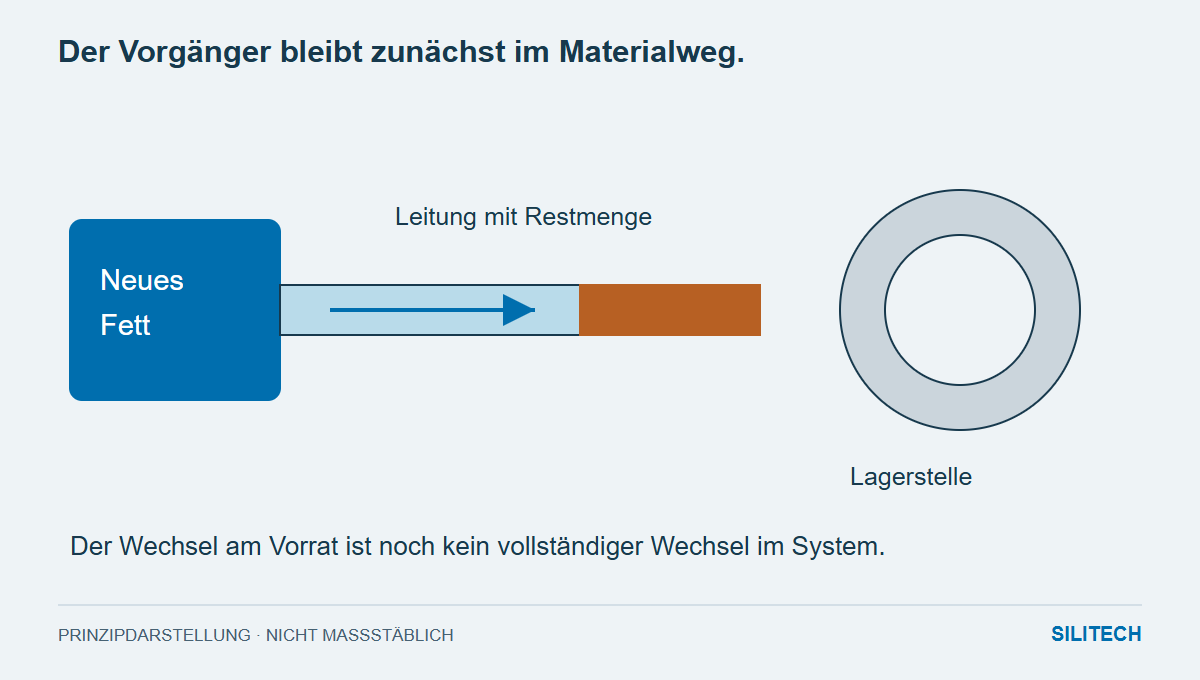
The press is receiving a new cartridge. The new grease type is noted on the maintenance schedule. However, the hose and storage compartment still contain the previous type. The actual changeover is only just beginning.
Two questions need to be answered separately for the changeover: Is the new grease suitable for the bearing location? And how does the transition behave with the existing material? A suitable single product will not automatically be compatible with every mixture of the old grease.
Why a mixture can behave differently
Base oil, thickener, and additives form a coordinated system. When two fats come into contact, their consistency and oil separation can change. ExxonMobil cites softening or hardening as examples of incompatibility. Using the same thickener family does not guarantee complete compatibility.
This is why "both lithium grease" or "both NLGI 2" does not provide a switching instruction. First, the exact two products must be known. Color and imprint on the press do not identify the wording.
Follow the entire material path
A simple sketch begins at the supply point and ends at the lubrication point. In between are the conveying device, the pipeline, and, if applicable, the distributor. Predecessor material can remain in each section.
A cleaned container, therefore, says nothing about the contents of the line. After the change, old grease may still reach the bearing initially. The first relubrication with a new cartridge is not necessarily the first time the bearing is supplied with new grease.
Removing, displacing, or dealing with residual components
If the old grease can be removed during the scheduled maintenance procedure, the new fill can be prepared without any issues. If any residue remains, its impact on the product pair and the transition must be assessed. A general compatibility chart can only aid in preliminary selection; it does not replace a specific evaluation.
Displacement also requires a permissible method. Guiding grease through a designated outlet is different from forcing more and more material into an enclosed space. Machine and maintenance specifications determine which method is possible.
The transition will end at the next maintenance appointment
The bearing's behavior is compared to a known baseline. Abnormal temperatures, noises, or vibrations trigger an investigation according to the system's specifications. A single hot run does not prove mixing incompatibility; conversely, a normal start does not confirm every long-term issue.
A complete changeover requires ensuring that the same product information is used on the maintenance schedule, lubrication point, and associated conveying equipment. Otherwise, the wrong product will be accidentally mixed back in during the next shift. The new cartridge is a start. Clear material identification throughout the entire system ensures a controlled changeover.
Two practical questions
How much lead time is sufficient when changing the grease gun?
A general stroke rate is meaningless without considering the delivery quantity and the contents of the conveying path. The appropriate procedure depends on the product pair and the system.
What to do if the previous variety is unknown?
First, clarify the container, maintenance data, and device assignment. If the identity remains unclear, the changeover procedure must explicitly address this uncertainty.
To deepen the connection
Technical Sources and Conditions
The current product documentation is decisive for processing.