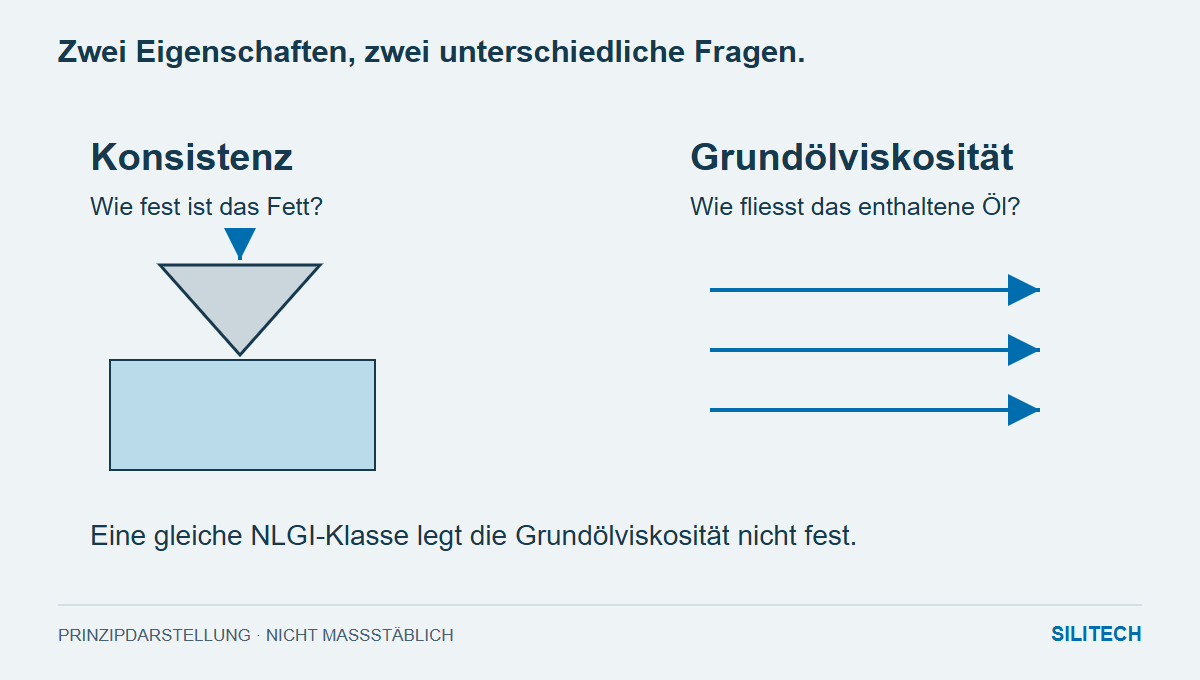
Two greases can be squeezed from the cartridge in a similar way and both bear the designation NLGI 2. However, they can differ significantly in their performance in bearings. The common number describes their consistency – not all of the lubricant's properties.
A grease consists of base oil, thickener, and, if necessary, additives. The thickener gives the system its semi-solid structure. The base oil and the rest of the formulation contribute to its behavior in rolling contacts. Therefore, selection requires more than just the impression it makes when dispensed.
What NLGI 2 measures – and what oil viscosity describes
The NLGI grade is assigned based on the penetration depth of a test cone under specified conditions. It describes how soft or firm the grease is. The base oil viscosity, on the other hand, describes the flow resistance of the oil at a specific temperature.
Two greases can therefore have the same consistency class but different base oil viscosities. An identical NLGI rating does not automatically make them equivalent candidates for the same speed, load, and temperature.
Cold starts pose a different question than long-term running
Let's consider a bearing that starts up in a cool hall in the morning and later warms up under load. At startup, the lubricant must not excessively impede movement. During operation, it must provide sufficient lubrication under the actual contact conditions.
JTEKT generally assigns lower base oil viscosities to lower temperatures and higher speeds; higher viscosities may be required at high loads or higher temperatures. This is a guideline, not a rule of "thicker is better." The bearing design determines the required range.
For a datasheet comparison, values at the same temperature must therefore be compared side by side. A value at 40 °C cannot be directly compared with a value at 100 °C. The temperature of the datasheet test and the subsequent operating conditions serve different purposes: one makes characteristic values comparable, the other defines the requirements.
The grease gun does not assess the rolling contact
Conveyability is also important, especially for pipelines and central lubrication systems. A grease might be suitable for bearing contact but cause problems with the existing supply. Conversely, trouble-free discharge does not necessarily guarantee suitable lubrication within the bearing.
When replacing an existing product, the first step is to compare the exact product names, base oil, thickener, and available specifications. This is followed by consideration of storage location and supply. If any old grease remains, the compatibility of the mixture is a separate issue.
NLGI 2 is used effectively as a characteristic of a specific product. The decisive selection is based on storage conditions, operating conditions, and the complete grease formulation.
Two practical questions
Does the color indicate anything about equivalence?
It does not reliably identify base oil, thickener, or additives. The exact product name and the associated technical specifications are decisive.
Can I determine the base oil viscosity by testing the consistency?
No. The tests describe various properties. The manufacturer's specifications are required for the base oil viscosity.
To deepen the connection
Technical Sources and Conditions
The current product documentation is decisive for processing.