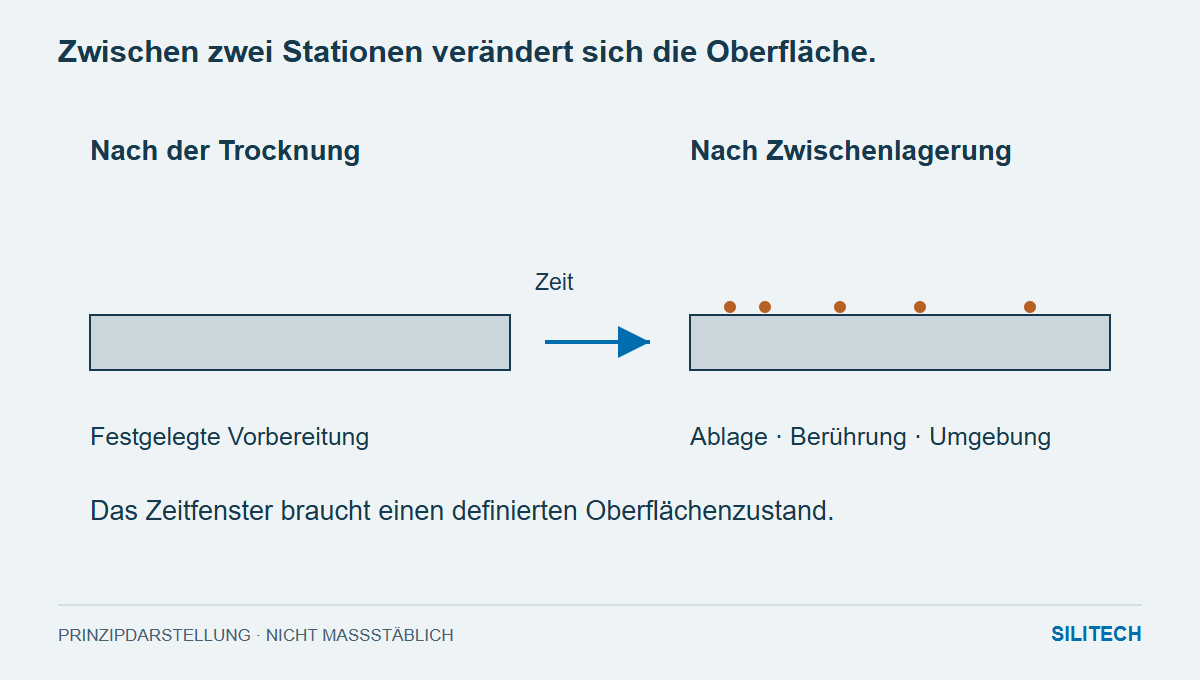
Two metal brackets are cleaned simultaneously. One is glued after the required drying time. The other remains in an open box until the next shift. Both are marked with the same tag on the routing slip. However, they may not be in the same condition at the point of gluing.
Cleaning removes unwanted substances from a surface. It does not subsequently protect that surface from further contact. A fingerprint, a dirty pad, or a subsequent work step can alter the surface's condition again, potentially leading to adhesion.
Two waiting periods with opposing tasks
After cleaning with solvents, the surface must dry according to the product instructions. This drying time is part of the preparation. Additional temporary storage after drying, however, constitutes further exposure to the environment.
The instructions for PERMABOND Cleaner A describe application followed by wiping or cleaning with a moistened, clean cloth; the surface then dries. Faster bonding methods must not skip this step. The phrase "bond as soon as possible" is misleading without reference to the completed preparation.
In some materials, the surface itself also changes. Permabond points out that aluminum rapidly reforms oxide after treatment. This does not result in a universally applicable time frame, but it does necessitate considering pretreatment and joining as an integrated process.
The box can be more important than the clock
For the two brackets, "four hours waiting time" would be an incomplete description. Four hours protected and without contact with the adhesive area is a different process than four hours loose between oily components. Therefore, time and handling cannot be arbitrarily interchanged.
An insightful comparison uses the direct process as a reference and also depicts the actual intermediate storage. Only if a difference emerges is a more detailed investigation conducted: same timeframe, different storage location; same storage location, longer delay. This allows the identification of which factors are relevant to this process.
A time window needs a defined beginning
The work instruction specifies the state after complete preparation and the latest permissible next step. For a primer, its drying and processing windows must also be observed. These do not automatically begin with the first cleaning step.
For layer changes, what happens to interrupted sections is particularly important. Re-cleaning must be appropriate to the existing surface structure; it's not simply the same procedure for a primer layer as for bare metal. The sensible limit arises from the tested process with the actual material – not from a blanket time limit for all bonded joints.
Two practical questions
Is covering always sufficient?
A clean, suitable cover can limit new contamination. It does not necessarily prevent all surface changes and does not replace product-specific time requirements.
Where does the waiting time begin in the work instruction?
At a clearly defined state, such as after drying or priming is complete. Cleaning time, flash-off time, and additional storage time should be distinguishable.
Mentioned in the article
PERMABOND Cleaner A Aerosol ↗To deepen the connection
Technical Sources and Conditions
The current product documentation is decisive for processing.