According to the datasheet, the adhesive achieves a tensile strength of 23 N/mm². The planned bonding area is 600 mm². This equates to a calculated force of 13,800 N. Can the holder withstand this force?
The multiplication is correct. Its interpretation as a permissible load is incorrect. The datasheet value comes from a specific sample. The holder has its own surface finish, force application, and different operating conditions. These differences determine whether the figure is even meaningful for it.
Same adhesive, three results
Henkel specifies tensile strengths of 23 N/mm² for LOCTITE EA 9483 on sandblasted structural steel, 10 N/mm² on sanded aluminum, and 21 N/mm² on anodized aluminum. Tensile shear tests were performed according to ISO 4587 after five days of curing at 22 °C; SiC paper P400A is specified for the sanded aluminum.
This is not a ranking of metals. It shows that the joining component and surface preparation are part of the measurement result. "Strength: 23 N/mm²" omits precisely the information from the report that would make the comparison understandable.
A large area can fail at a small edge
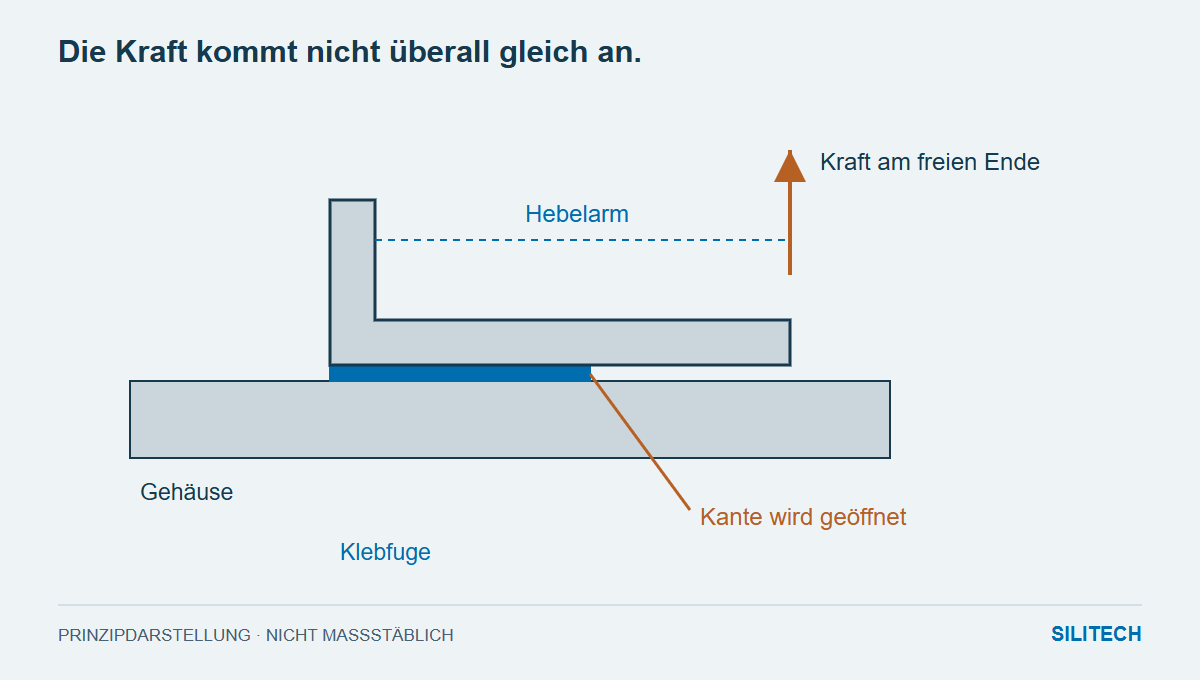
Consider an angle bracket mounted on a housing that guides a cable. If the cable pulls on the protruding leg, a lever effect is created. This opens part of the adhesive joint. The stress is concentrated at one edge; it is not distributed evenly across the entire surface.
Therefore, increasing the bonding surface far behind this edge does not help in the same proportion as in the simple calculation. A shorter overhang or a more favorable force application can be more effective than switching to the adhesive with the next highest data sheet number. For this reason, Permabond recommends limiting peel and splitting stresses during the design phase.
With powder-coated housings, an additional bond comes into play: the coating on the metal. If the adhesive bonds firmly to the paint, but the paint detaches from the housing, the load will still not be transferred. The structure is only as load-bearing as the layered composite actually subjected to stress.
This turns a comparison of numbers into a selection
For the initial selection, only strength ratings with comparable testing methods, surface finish, and curing properties are considered. The bond is then examined: Where is the force applied? Which edge could open? Which layer does the adhesive touch?
A test with the intended holder then answers the question left open by the data sheet. It encompasses the actual surface condition, the mounting, and the relevant load case. The design – including the necessary reserves – is derived from the test results and the requirements. A blanket safety factor applied to the 13,800 N does not yet transform the initial miscomparison into a reliable proof.
For a material inquiry, a sketch with force arrow and lever arm is therefore often more valuable than an additional decimal place in the strength value.
Two practical questions
What does N/mm² mean in this context?
The unit describes a stress. In tensile shear testing, the measured breaking force is related to the overlapped adhesive surface. This does not prove that the stress is uniform throughout an arbitrary component.
Should I ignore the higher datasheet value when making my selection?
No. Under comparable testing conditions, it helps with the pre-selection. For the holder, geometry, surface, temperature, aging, and load type are additional factors.
Mentioned in the article
LOCTITE EA 9483 - Highly transparent epoxy adhesive ↗To deepen the connection
Technical Sources and Conditions
The current product documentation is decisive for processing.