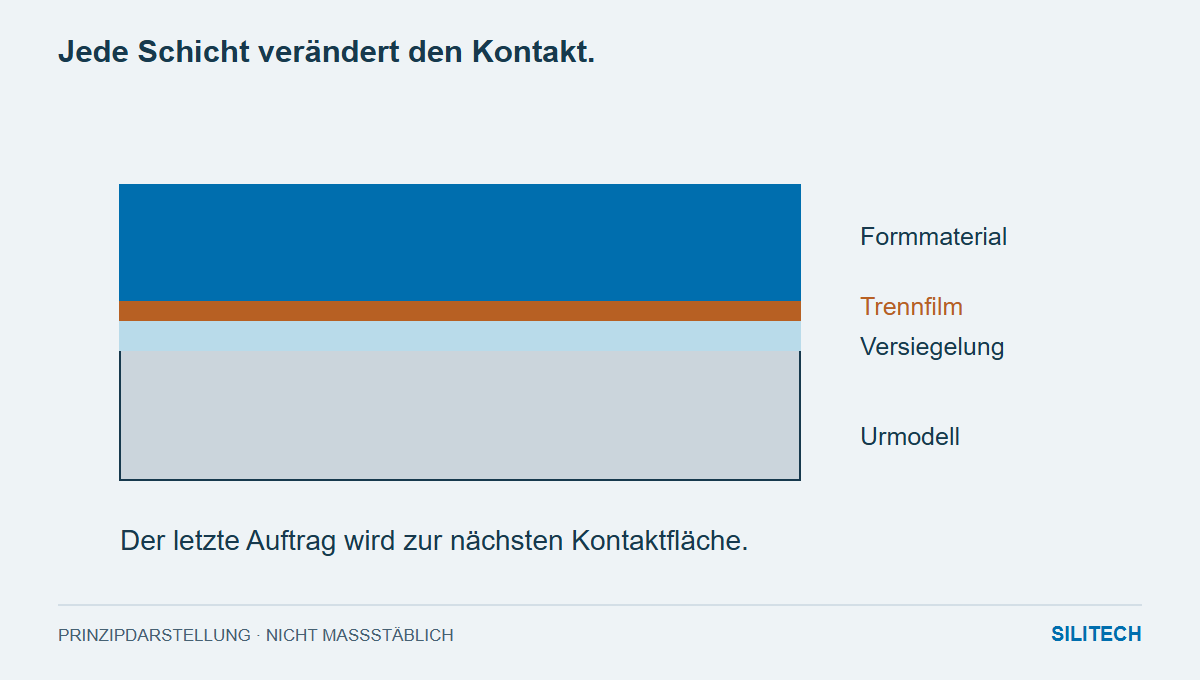
A sanded model appears uniform. However, beneath the surface, wood, filler, and an inserted plastic detail alternate. These represent different contact zones for the liquid molding material.
Open pores can absorb material and make subsequent separation more difficult. A suitable sealant creates a different, more closed surface. A release agent, on the other hand, facilitates separation at the interface. A product designed for this purpose can combine both functions; the term "release agent" alone does not indicate this.
Each layer becomes the next substrate
After sealing, the silicone no longer comes into contact with the wood, but with the sealant. This may solve the porosity issue, but it raises a new question about compatibility.
Certain contact materials can inhibit the curing of addition-curing silicones. For BLUESIL RTV 3428, Elkem lists certain rubbers, condensation-curing silicones, and amine-curing epoxies as examples. If contact is unclear, the manufacturer recommends conducting a small test on the substrate.
The appropriate test object is therefore the completed layer sequence: base material, filler, coating, and, if applicable, release agent. Successful contact with the bare base material says little about the subsequent applications.
The difficult transition belongs in the short rehearsal
For a wooden model with a filled edge, a clean piece of wood would be too simple. The sample should include the transition and its processing. If a fine groove is added, it will also become visible whether the preparation obscures or alters details.
Several specific results are evaluated: the condition of the silicone surface at the point of contact, the removability, and the reproduction of detail. These belong to the same pattern but may differ. A mold that is easily removable with a sealed engraving serves a different purpose than a highly detailed mold that adheres to the model.
Dry is not always ready for the next shift
A superficially dry appearance does not necessarily mean that the waiting time required by the product has been reached. For multi-layered structures, the transitions between the layers and the condition before molding are crucial.
Adding extra layers based on suspicion makes it harder to identify the cause of an anomaly. Therefore, a targeted comparison modifies a defined part of the sequence while leaving the remaining steps verifiably unchanged.
The original remains a separate requirement
With a valuable model, how the treatment alters its surface is also important. A successful cast does not justify every irreversible preparation. Therefore, material selection begins with the question of which modifications to the model are permissible.
To clarify the situation, a photo of the critical transition and the exact layer sequence are helpful. The seemingly uniform outer surface alone conceals what the molding material will actually come into contact with.
Two practical questions
Does every painted model also need a sealant?
Not a general rule. The decisive factors are the existing surface condition, open areas, and the compatibility of the entire sequence with the molding material.
Can a release agent reliably prevent crosslinking inhibition?
Only if the specific combination is suitable. A separating effect alone does not prove a reliable barrier against the respective contact substance.
Mentioned in the article
BLUESIL RTV 3428 A + B Kit Translucide ↗To deepen the connection
Technical Sources and Conditions
The current product documentation is decisive for processing.