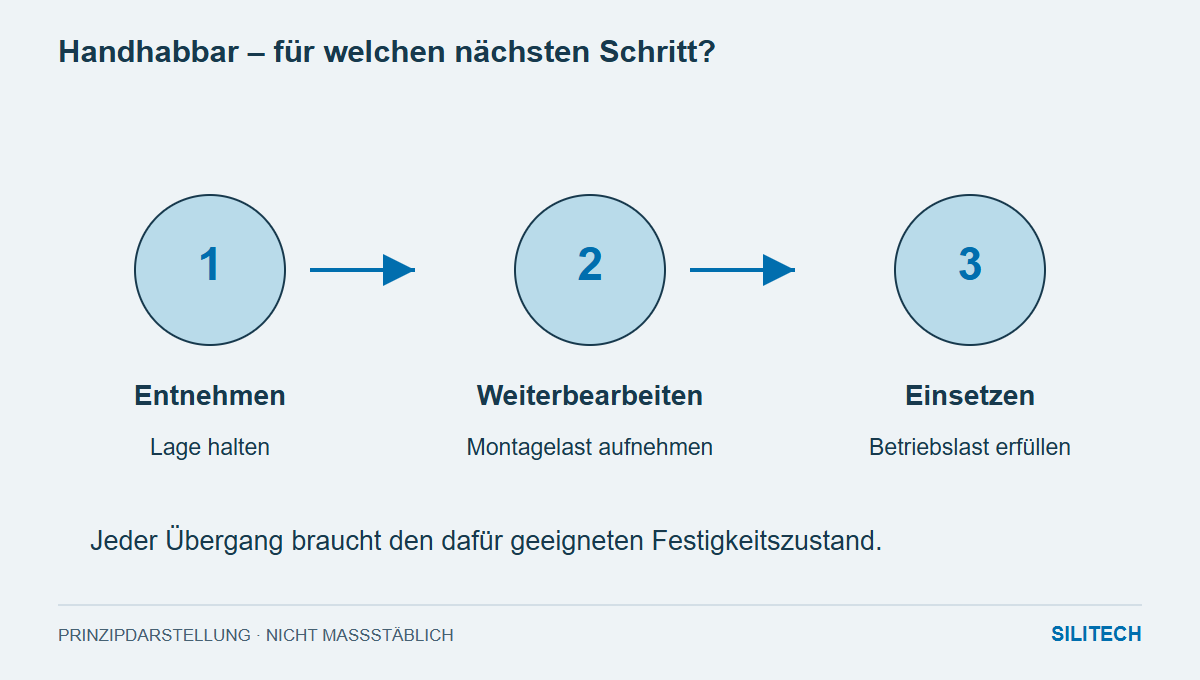
A freshly glued holder remains in place after the device is opened. At the next station, a connector is pressed onto it. This is the first time a significant force is applied to the holder.
For material flow, this means there are two release points. First, the connection must hold its position. Then, it must withstand the handling during assembly. A single statement like "ready in twenty minutes" can obscure this difference.
Datasheet times describe different states
PERMABOND ET515, according to the TDS at 23 °C, distinguishes between 20–30 minutes handling time, 24 hours until working strength, and 72 hours until full curing. This information is taken from Global TDS Revision 7 dated December 6, 2019.
The figures serve to classify the product. The load a specific assembly can withstand at any given time also depends on the joint, surface, temperature profile, and load case. Therefore, the term "manageable" is not a universal limit for every subsequent handling step.
The first load is often not included in the test plan
A cable is repositioned, a component is lifted on its holder, a clamp is slid into place. Such manual actions can stress the adhesive bond sooner than the official functional test.
The lever arm of the holder deserves particular attention. Even moderate insertion force at the end of a protruding component can open the adhesive bond at an edge. Simply testing whether the holder falls off on its own does not account for this.
A free fixture is not yet a ready-to-ship part
The process can have several useful states: position sufficiently stable for removal, connection ready for plug-in assembly, assembly ready for the intended test. This allows the device to be used again while the part continues to cure under suitable conditions.
This is more relevant for capacity planning than a single long waiting time. However, the intermediate buffer must be maintained in the correct state. If parts are stacked there or transported via the holder, the next load is created.
The attempt captures the actual hand movement
Samples are exposed to the next actual movement at the scheduled handover time. A control group, tested after a longer curing period, helps to classify the temporal influence. The subsequent evaluation depends on the function; a simple visual inspection alone does not detect all possible pre-existing damage.
The temperature of the setup is currently being monitored. The oven setting does not automatically determine the temperature of the adhesive joint. A heavy metal part requires a different curing time profile than a thin sample.
The precise question is therefore not "When will the adhesive be ready?", but rather something like: "When can this connector be assembled in this geometry?". This turns a general material time into a concrete manufacturing question.
Two practical questions
Can I take over the handling time for shipping?
Only if the stresses occurring during shipping are covered by the achieved condition. Removal, further processing, and transport can place different demands on the product.
What are the benefits of removing the device earlier?
It can release capacity if the part maintains its position and subsequently cures appropriately. Subsequent loads must be considered separately in the process.
Mentioned in the article
PERMABOND ET515 ↗To deepen the connection
Technical Sources and Conditions
The current product documentation is decisive for processing.