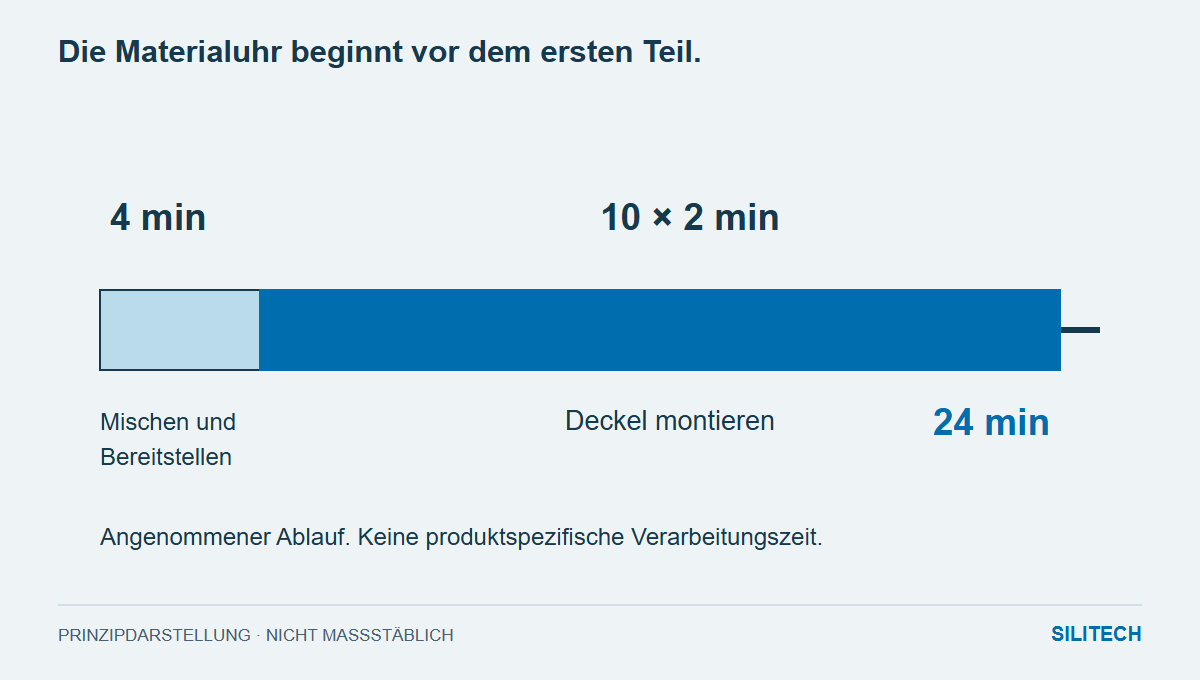
Ten lids, two minutes of assembly per lid: The job seems to be done in twenty minutes. However, if mixing and preparation take four minutes beforehand, the last lid won't be fitted until 24 minutes later.
The figures are a hypothetical example of cycle times. They illustrate a common planning error: The manufacturing clock starts with the first part. The material clock starts earlier, as soon as the reactive components come together.
Pot life is tied to a trial
A time value in the data sheet has an endpoint and test conditions. It is not a universal remaining time that is the same for every machine and every batch size.
Henkel notes that LOCTITE EA 9483 requires a shorter processing time at higher temperatures or with larger batches. The data sheet also limits the mixing quantity to a maximum of 500 g to prevent excessive heat generation. This limit is not a guarantee that every smaller batch will work flawlessly in the desired process.
Increasing the quantity changes the material conditions
Doubling the amount of material used for twenty lids instead of ten not only increases assembly time but also brings more reactive material together. In exothermic systems, the temperature profile depends, among other things, on how heat is generated and dissipated. A larger volume in the same type of container has different properties than a thinly distributed amount.
Therefore, a successful small-scale approach cannot be simply scaled up to a large production run using a rule of three. The alternative might be to produce smaller batches in a logical sequence or to modify the production process and division of labor.
"Still coming out of the nozzle" is a criterion that's too late
For the lid, the mixture still needs to be applied, wetting the surface and allowing for positioning. A state where it is just barely spreadable may already be unsuitable for this.
The test point is therefore at the end of the required work step: Can the last cover be fully fitted in the intended sequence, and does its connection later meet the requirements? The first cover cannot answer this question vicariously.
The time study follows the entire approach
The start of mixing, preparation, and the first and last joining steps are assigned in the experiment. The parts retain their order. Planned interruptions are included if they occur later in the workplace.
This reveals whether an anomaly coincides with the increasing age of the mixture. A justified reserve is derived from process fluctuations and the tested operating window. It is not achieved by altering the mixing ratio.
The best starting point for the technical analysis is a short timeline including batch size, container, and material temperature. This shows where time is being consumed – and which part is actually limiting the process.
Two practical questions
If the first attempt works, can I simply double the amount of product?
This will change the processing time and potential heat generation. The new quantity and the entire process must be assessed within the product specifications.
Which time is counted when there are multiple assembly steps?
The entire required sequence, from the joining of the components to the completion of the relevant joining process. A subsequent stress-bearing step also has its own curing requirement.
Mentioned in the article
LOCTITE EA 9483 - Highly transparent epoxy adhesive ↗To deepen the connection
Technical Sources and Conditions
The current product documentation is decisive for processing.