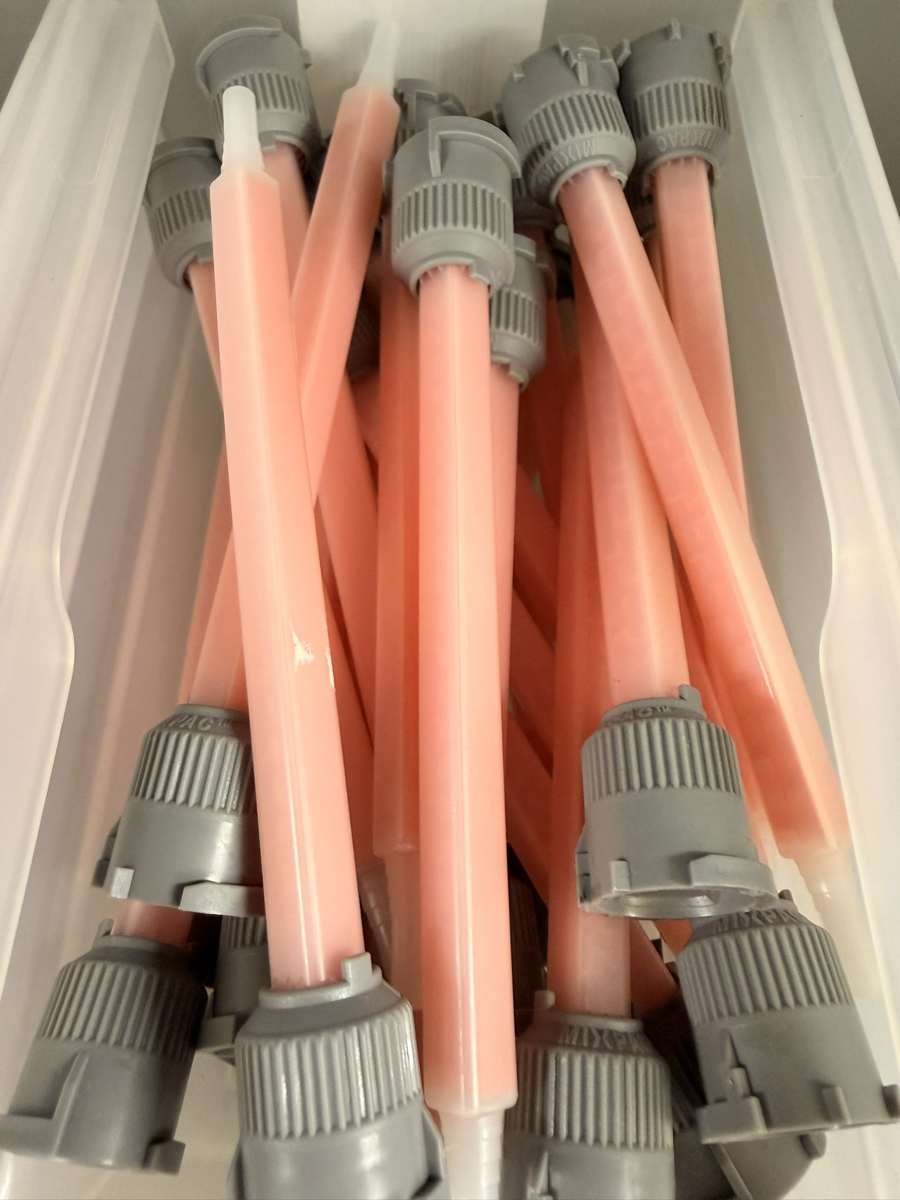
The new adhesive meets the required durability standards. The cartridge can be inserted, and the existing mixing tip attached. The changeover therefore seems minimal. However, in manufacturing, it may still mean a new process.
The mechanical connection only answers the question of whether the parts fit together. It says neither whether the correct component ratio is being conveyed, nor whether the mixer achieves sufficient mixing with this material and discharge rate.
What actually happens in the static mixer
The components flow past stationary elements. The flow is split and recombined. This doesn't require a rotating agitator, but rather a suitable combination of mixer geometry, material, and throughput. medmix differentiates its disposable mixers based on factors such as inlet, diameter, and the number or design of the mixing elements.
A shorter mixer can save material in the dead volume. However, it also changes the mixing distance. A larger opening can facilitate discharge and also alters the flow. Such modifications are part of the process design, not merely accessory choices.
The change alters two clocks
The first phase runs from the assembly of the components to the completion of the joining process. During this time, the adhesive must still be able to wet, spread, and position itself as intended. The second phase runs until the required strength levels are reached: removal from the fixture, the next load-bearing operation, and subsequent use.
A faster-curing replacement product can release a fixture sooner and simultaneously reduce the available assembly time. In an assembly with ten parts, this might make the first cycle cheaper and the last more critical. The price per cartridge does not reflect this relationship.
Surface and breaks are part of the comparison
For mounting on a painted housing, the candidate is tested on the existing paint. If it requires a different cleaner or primer, this additional step is part of the conversion process. A successful test on bare metal would bypass the existing application.
The experiment also includes the everyday dosing process: cartridge start, normal discharge, and the usual interruption. After a pause, there is already reactive material in the mixer. A pattern that only arises during uninterrupted operation leaves this weakness unexplored.
Compare the replacement as a complete process
Ultimately, two combinations are available: the existing adhesive with its process and the new adhesive with its required process. The decision depends on the bond produced, the necessary equipment, the processing times, and the material loss during start-up and changeover.
For the technical inquiry, the exact cartridge, the mixing tip, and a brief description of the process steps are therefore helpful. This information will clarify what can remain unchanged and what the new material actually alters.
Two practical questions
Is a longer mixing tip generally better?
Additional elements alter the mixing effect, pressure requirements, and the amount remaining in the mixer. The appropriate design depends on the system and the intended discharge.
Can I compare two adhesives with the same instructions?
Only insofar as this instruction applies to both. Different necessary preparation or curing times are specific to each candidate and therefore also to the comparison.
To deepen the connection
The current product documentation is decisive for processing.