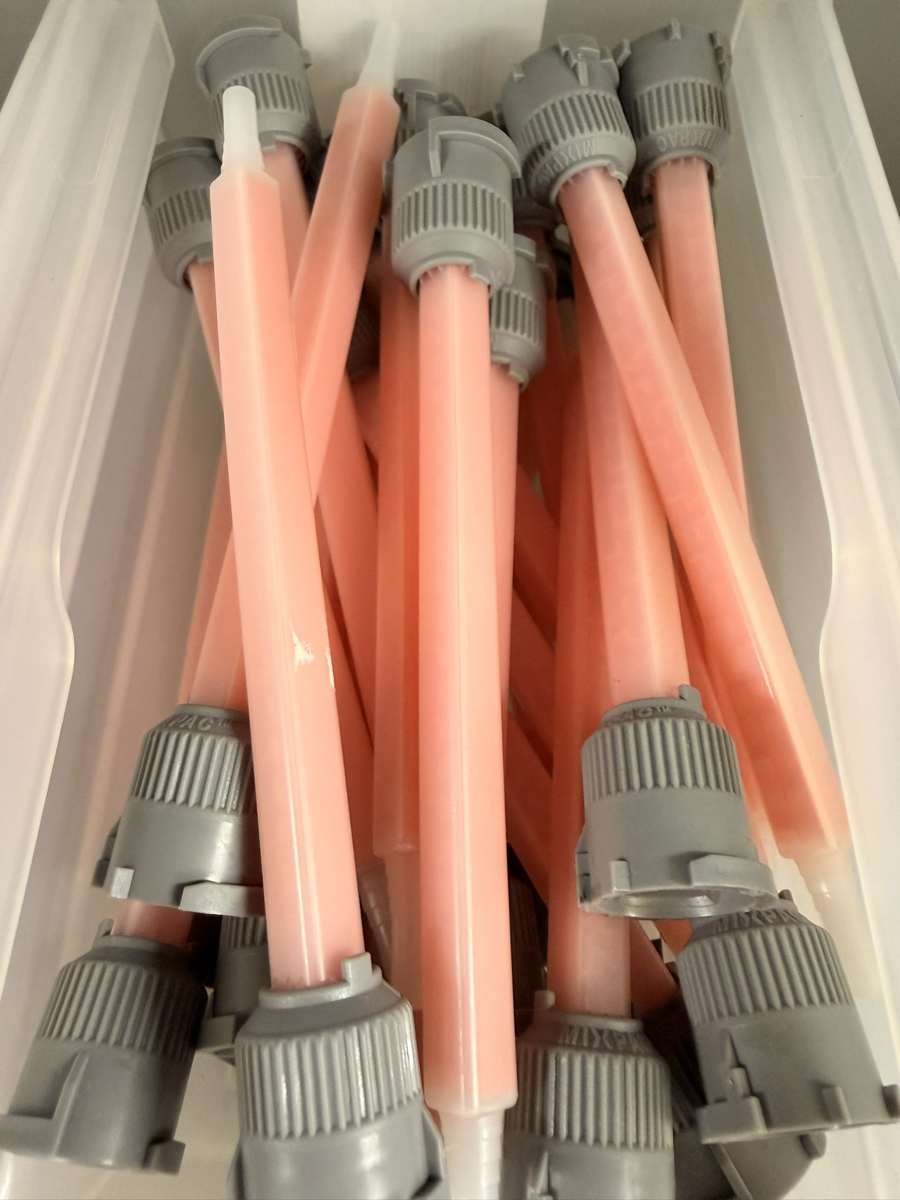
The assembly line is waiting for a missing part. The double cartridge remains in place, the mixing nozzle is filled. Ten minutes later, work resumes. For the operator, this was a pause; for the material in the mixer, it was additional reaction time.
This difference explains why a sampling process running continuously at high speed can overlook an important condition. The material that emerges first after the interruption has a different history than the mixture that subsequently flows fresh through the mixer.
Pot life is not automatically the permissible rest period
Pot life is dependent on specific test conditions. Temperature, quantity, and geometry used influence processing. PERMABOND ET515, for example, specifies a reduction in pot life at higher temperatures and larger mixing quantities. Therefore, the value obtained from a defined composite sample is not necessarily the stagnation limit of any given mixing tip.
Furthermore, the usable working window doesn't end only when no more material comes out. The mixture must still provide sufficient wetting and be processable in the intended joining process. A visually inconspicuous bead only partially answers this question.
Three samples demonstrate the transition
For a test with a planned interruption, the last connection before, the first after, and a subsequent connection from the ongoing transmission are considered separately. Restarting occurs according to the specifications of the system used.
If only the first compound fails, it will show a different pattern than a continuous deviation. A combined sample from the entire discharge would blur the transition. It is precisely this seemingly small detail – which part formed first – that makes the test meaningful.
A new cartridge is a different starting state
When starting the cartridge, the supply to both sides must first be correct. For the ET515, the instructions describe dispensing without the mixer attached until both components are flowing; then the mixing tip is attached. This is a product-specific starting instruction and not a universally applicable pre-flow quantity.
The process for a new cartridge, a permissible short interruption, and a mixer change should be distinguishable. They have different initial states. A single sentence like "express something before use" leaves open what problem it is supposed to solve.
The break rule must work even without a reminder
After a shift change, the next person may not know how long the system has been idle. In such cases, a defined restart procedure is necessary for unknown or exceeded break times. The decision should not depend on whether the nozzle can still be pressed.
The helpful materials query specifies the adhesive, cartridge, mixing tip, and typical interruption. This allows the limits to be clarified on the actual system – and the first connection after a break to be taken just as seriously as the fiftieth during a marathon.
Two practical questions
Can I extend the break indefinitely by using a longer lead time?
No. The pre-run and mixer changeover follow the specific system and a tested procedure. An unknown or exceeded break limit is not overridden by a freely chosen discharge quantity.
Which sample is frequently missing from the usual sampling process?
The first connection after a realistic interruption. Parts manufactured exclusively under continuous operation do not examine this transition.
Mentioned in the article
PERMABOND ET515 ↗To deepen the connection
Technical Sources and Conditions
The current product documentation is decisive for processing.