The cartridge states 2:1. For manual mixing, 100 g of resin are weighed out and 50 g of hardener are added. That sounds logical – but it's only true if the 2:1 ratio explicitly refers to mass.
A volume ratio describes spatial volumes. A mass ratio describes weights. Components can have different densities; the same numbers then denote different mixtures. Therefore, a ratio is always read with the component order and a reference quantity.
A concrete example from recipe to display
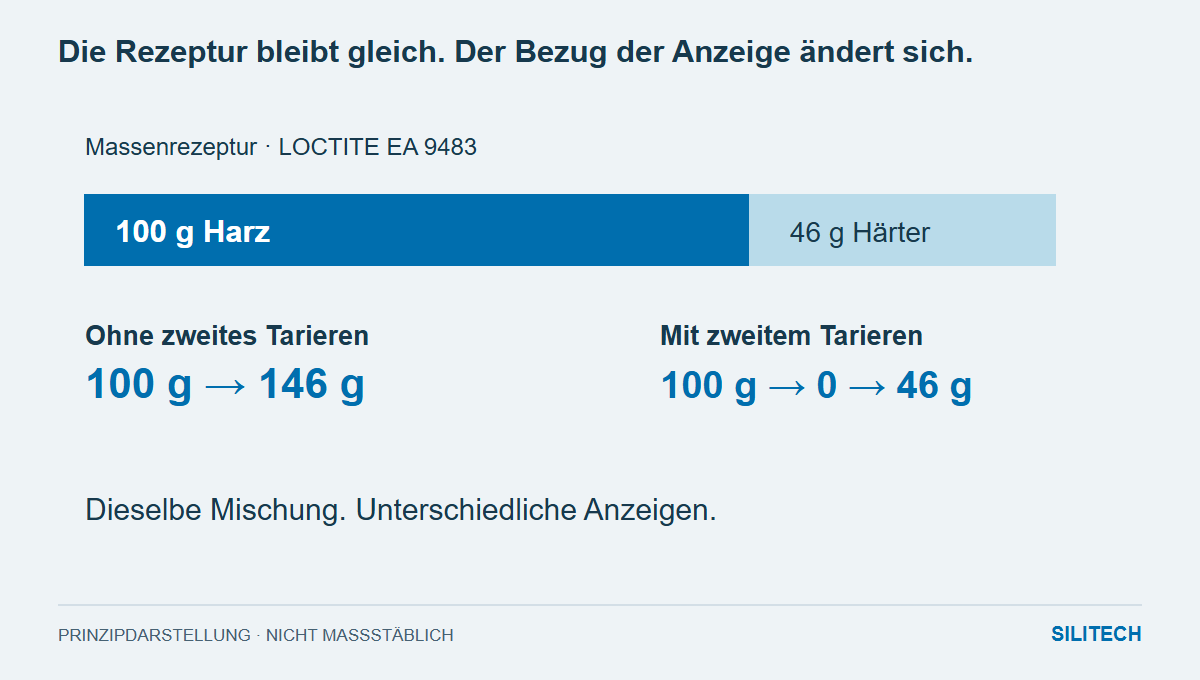
Henkel specifies a resin-to-hardener ratio of 100:46 by mass and 2:1 by volume for LOCTITE EA 9483. A 146 g batch therefore contains 100 g of resin and 46 g of hardener.
After taring the empty container, there are two correct weighing procedures:
| working method | Advertisement for Harz | Display after hardener |
|---|---|---|
| Do not re-balance between components | 100 g | 146 g |
| Reset to zero after removing the resin | 100 g, then 0 g | 46 g |
The recipe is identical. Only the reference for the second display changes. A work card with "100 / 46" without tare instructions is therefore incomplete.
Divide another total quantity correctly
In a mass ratio A:B = a:b, component A receives the proportion a/(a+b) of the total quantity; component B receives the remainder b/(a+b). In this example, that's 100/146 and 46/146.
A smaller batch of 73 g therefore consists of 50 g resin and 23 g hardener. These two amounts are added together to determine the total quantity. However, calculating the hardener content from the already determined total quantity as if it were pure resin would result in too much material.
Small quantities place higher demands on the scale
The display alone does not describe the accuracy. What matters is how reliably the smaller individual quantity can be dispensed. A resolution of one gram is different for a hardener quantity of two grams than for two hundred grams. The permissible ratio deviation results from the specific material and process specifications; it is not derived from the number of decimal places.
Scaling up also has its limits. The EA-9483 datasheet excludes batches larger than 500 g and indicates shorter processing times for larger quantities or higher temperatures. Therefore, a mathematically correct ratio does not make an arbitrarily large batch usable.
After weighing, a second task follows: thorough mixing. The scale confirms quantities. It does not confirm that these quantities are evenly distributed on the floor, walls, and throughout the entire mixture.
Two practical questions
Can I calculate the mass ratio myself from two density values?
Mathematically, a volume ratio can be converted using suitable densities. However, for processing purposes, the manufacturer's specified formula is preferable; density ranges or values at different temperatures are not a precise substitute formula.
What should I do if I have overdosed on a component?
Record the actual quantities and apply the intended correction or rejection procedure. A spontaneous addition will change the total quantity, the start of mixing, and potentially the available working window.
Mentioned in the article
LOCTITE EA 9483 - Highly transparent epoxy adhesive ↗To deepen the connection
Technical Sources and Conditions
The current product documentation is decisive for processing.