Batch A contains the correct quantities, but shows streaks after brief stirring. Batch B looks uniform, but contains too much hardener. Both batches are conspicuous – for different reasons.
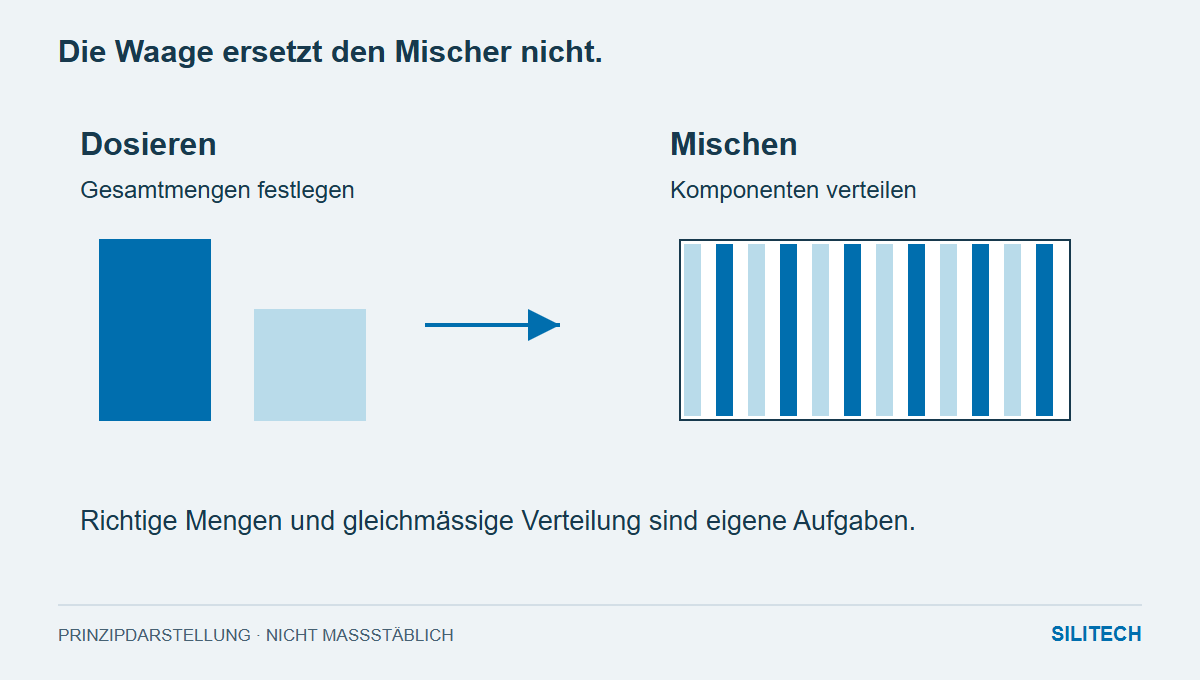
Dosage determines the composition of the entire mixture. Mixing distributes the components within this mixture. Prolonged stirring cannot correct an incorrect total quantity. Conversely, a correct weight does not guarantee that the components are evenly distributed.
Globally correct, locally wrong
When mixing by hand, areas may remain on the walls and floor that were not sufficiently incorporated into the mixing process. The scale accurately recorded these quantities. However, in the subsequently poured mixture, these areas may still appear as unevenly composed zones.
A helpful analogy is a beaker whose center is vigorously stirred, while material remains at the edges. Simply increasing the speed in the center doesn't automatically solve the edge problem. The tool, the container, and how these areas are integrated into the production process are crucial.
In a static mixer, fixed elements handle the distribution within the flowing material. The metered quantities must be precisely matched right from the inlet. A suitable mixer cannot compensate for a consistently incorrect flow ratio and achieve the correct formulation.
A uniform color does not represent a quantity log
With components of different colors, streaks can reveal insufficient distribution. If both components are colorless, this aid is absent. PERMABOND ET515 is such an example: The datasheet describes both the resin and hardener as colorless.
Even with a clear color contrast, an optically uniform mixture initially only tells you something about the visible distribution. A variation in quantity can still exist. Color only becomes a quantitative statement when a suitable, validated measurement method is available.
Troubleshooting follows the deviation
If incorrect weighing is known, the investigation begins with the formulation, reference quantity, and dosing procedure. If the quantities are correct and local anomalies remain, the focus shifts to the mixing process and handling. A subsequent material or compound test evaluates the required result.
This separation prevents a common dead end: the mixing ratio is changed, even though the distribution actually needs to be improved. This results in two altered variables, and any subsequent success is difficult to explain.
At the workplace, the documentation can be correspondingly concise. The individual quantities answer "how much?", the mixing tool and process "how distributed?", and the result check "which property was achieved?". Together, they explain the approach much better than a single checkmark next to "mixture OK".
Two practical questions
Can a dosing control behind the static mixer determine the ratio?
The total volume of the mixed discharge alone is no longer sufficient to separate the individual components. A suitable testing procedure must capture the quantity relationships for the specific dosing system.
Is every visible streak proof of improper mixing?
It is an anomaly that must fit the material description. To determine the cause, the composition, mixing process, and other possible effects are considered separately.
Mentioned in the article
PERMABOND ET515 ↗To deepen the connection
Technical Sources and Conditions
The current product documentation is decisive for processing.