


 Silicones, silicone oils, sprays
 Casting and potting resins

Suppose a small adjusting screw on a guide needs to hold its position. During servicing, it must be loosened and readjusted. For this component, future tool access is already a factor in the adhesive selection.
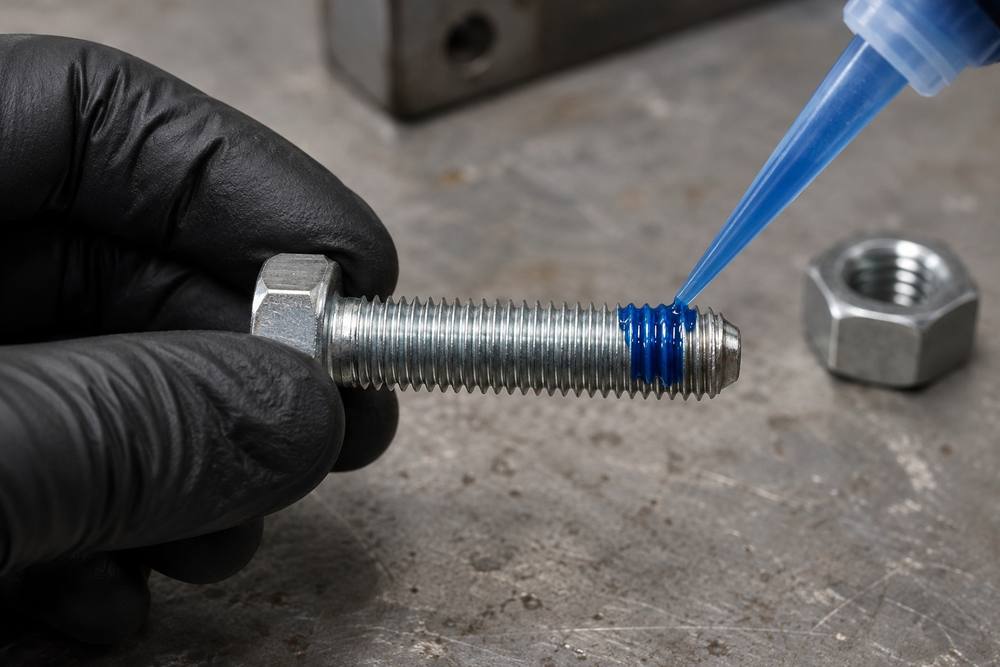
The crucial factor is a connection that fulfills both tasks: ensuring a secure connection during operation and remaining detachable as intended during maintenance. The highest strength class does not automatically meet this dual requirement.
Three product examples, three selection directions
Henkel describes the following threadlockers with different strength and disassembly properties:
| Product | Strength class and described disassembly |
|---|---|
| LOCTITE 222 | Low strength; can be disassembled with hand tools, described for small screws and adjusting screws, among other things |
| LOCTITE 243 | Medium strength; disassembly with standard hand tools |
| LOCTITE 270 | High strength; datasheet describes localized heating during disassembly |
The information is based on the respective data sheets: LOCTITE 222, May 2022, LOCTITE 243, April 2025 and LOCTITE 270, November 2024.
Low strength in 222 also means a securing function against loosening due to shocks and vibrations. For the adjusting screw, it is additionally checked whether the tool can be applied straight and how sensitive the screw head and mating component are.
In contrast, a heat-assisted disassembly method must be compatible with the surrounding environment of the connection. Adjacent temperature-sensitive components can limit this service route. The decision is therefore based on the design, not on a general ranking of strength classes. Maintenance frequency is also a factor: Is the adjustment regularly changed, or is the screw only loosened during infrequent repairs? The intended procedure determines what is examined during the disassembly test.
The thread is part of the reaction system
Anaerobic threadlockers cure in the narrow metallic gap under anaerobic conditions. The metal surface area, gap, and temperature influence the curing rate; Henkel describes these influences in the 222 data sheet.
Therefore, the pattern is used with the intended threaded components. A coated screw is not simply replaced by a bare one, nor is a different fit treated as a minor option. Furthermore, excess material outside the thread is subject to different conditions than the material within the assembled gap.
243 is described for active and passive metal surfaces and, according to the datasheet, tolerates minor residues of certain oils. The required cleaning procedure remains part of the process nonetheless. An activator is also selected based on the product and the conditions; it is not a mandatory addition to every anaerobic compound.
Distinguish between assembly, initial load and disassembly
During assembly, the screw is tightened to the specified tightening torque for the connection. The breakaway torque in the adhesive data sheet, on the other hand, describes a test result obtained during subsequent loosening.
These values serve different purposes. For example, the 270 strength ratings are tied to specific screws and nuts, materials, hardening conditions, and testing procedures. Therefore, they are not used as the assembly tightening torque for the adjusting screw.
Furthermore, a curing phase occurs between tightening and the first intended load. The duration and conditions of this curing phase are defined for the test. Thus, the prototype setup encompasses the same transition that will later be required in production.
Disassembly is included in the sample order
The test for the adjusting screw doesn't end after the safety check. It is then loosened and readjusted using the designated service tool. In addition to ease of loosening, damage to the head and mating component is also taken into account.
The comparison thus yields two results: behavior under the agreed operating load and behavior during planned service. These results remain tied to the threaded components, surfaces, and conditions examined.
For your inquiry, please provide the thread size, materials, coating, and a brief description of the subsequent tool access. Discuss threadlocking with SILITECH.
Frequently asked questions
Which change to the purchased part should be reconsidered?
Changing the thread surface, coating, or fit can alter relevant curing conditions. The tested setup should be compared with the new part design.
What else besides solving the problem should be included in the service check?
The intended tool access and the condition of the screw head and mating component afterward. The screw must be able to be machined in the planned procedure, not merely loosenable under any arbitrary laboratory condition.
Sources
- Henkel: LOCTITE 222.Retrieved 2026-10-25.
- Henkel: LOCTITE 243.Accessed 2026-10-25.
- Henkel: LOCTITE 270.Accessed 2026-10-25.