




 Silicones, silicone oils, sprays
 Casting and potting resins

Suppose a silicone mold cleanly reproduces an undercut. However, when removing it, the thin ridge next to it tears. A harder silicone is suggested for the next batch.
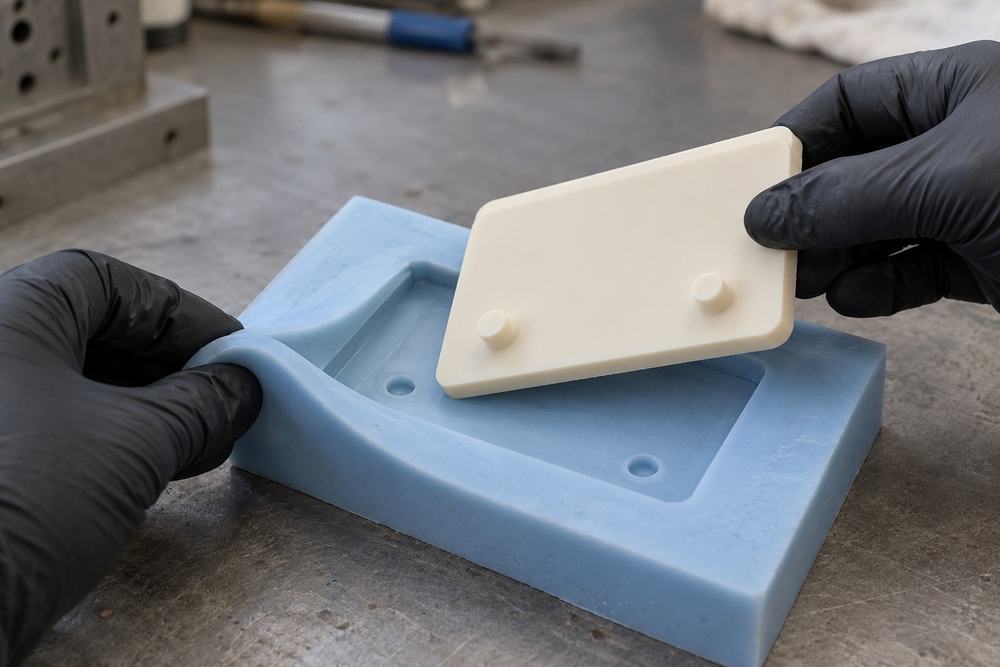
The proposal already makes a certain assumption: increased hardness is intended to prevent cracking. To plan the experiment effectively, it must first be clear what property the Shore value represents – and what stress the bridge experiences during demolding.
Pushing, stretching, and tearing are different tasks
The Shore test measures the resistance to penetration by a defined indenter under a standardized spring load. The hardness value is derived from the penetration depth. In contrast, a tensile test examines the behavior of a specimen under tension. A tear propagation test considers how an existing cut or crack propagates under load.
ZwickRoell lists these methods as separate tests on elastomers. This leads to an important selection question for the shape: Does it require different indentation behavior, different tensile behavior, or greater resistance to crack propagation? ZwickRoell: Elastomer Testing
The answer begins at the damaged bridge. Where does the crack start? Does the area require a significant undercut? Is the same edge subjected to stress during every demolding? Changing the material, increasing the wall thickness, and using a different parting line would be different approaches. If implemented simultaneously, their individual contributions become difficult to distinguish.
The scale is part of the hardness rating
"30 Shore A" is a more complete measurement than "hardness 30". Shore A is often used for softer elastomers, Shore D for harder materials; scales such as Shore 00 are suitable for particularly soft materials.
The scales differ in the indenter and spring characteristic. Therefore, a Shore D rating is not simply a continuation of the Shore A scale. When comparing data sheets, the scale and method must be compatible; the reading time is also part of the measurement. ZwickRoell: Shore hardness testing
The exemplary value of 30 Shore A, on its own, does not tell us how the thin mold rib can be pulled over the undercut. For that, we need to consider the mold geometry.
Two samples make the selection process transparent
For the next experiment, a suitable material sample and a representative mold geometry will be produced from the same batch. The material sample will be used for hardness testing, and the mold for demolding.
For hardness testing, proper specimen support, orientation, and geometry are crucial. ZwickRoell specifies flat, parallel support surfaces and a test stand for vertical positioning for its digital instruments. The thin, curved mold wall is therefore not directly comparable to a datasheet test specimen. However, the scale, curing state, temperature, and reading time remain verifiable during comparison. ZwickRoell: Instrument Information
In contrast, the critical demolding path is replicated on the mold template. Beforehand, it is determined what will be examined: Does the bridge remain undamaged? Does the model detach without the previously critical pull? Is the contour preserved? Photos of the same area before and after demolding facilitate comparison of the variants.
Make the material decision based on both results
One candidate might achieve the desired Shore value but still fail during demolding. Another might perform better, even though its hardness differs from the initial target value.
The separate results explain this difference: the hardness measurement describes a material property, while the demolding test describes the behavior of the mold under investigation. A pre-defined sequence of castings can then be used to examine the repeatability under these conditions.
For a specific inquiry, the existing material, a sketch of the bridge, and the indicated demolding direction are particularly helpful. Discuss application →
Frequently asked questions
Two silicones have the same Shore A value. Can their shapes tear differently?
Yes, the same hardness value does not determine tensile and tear behavior. These properties, along with the demolding test on the critical geometry, are additionally considered for selection.
How can the repeatability of the shape be investigated?
With a pre-agreed sequence of castings and the same assessment of the critical point. The result applies to the investigated conditions; no general mold lifespan is derived from it.
Sources
- ZwickRoell: Shore hardness test. Retrieved 2026-10-25.
- ZwickRoell: Elastomer testing. Accessed 2026-10-25.
- ZwickRoell: Digital Shore Devices. Retrieved 2026-10-25.