


 Silicones, silicone oils, sprays
 Casting and potting resins

JOINTS / QUANTITY PLANNING & PROCESSING
The required amount of sealant can be calculated from the joint width, joint depth, and total length. The following example shows the conversion to cartridges and pouches. You will also find information on product selection and the repair of existing joints.
Joint width, depth and backfilling
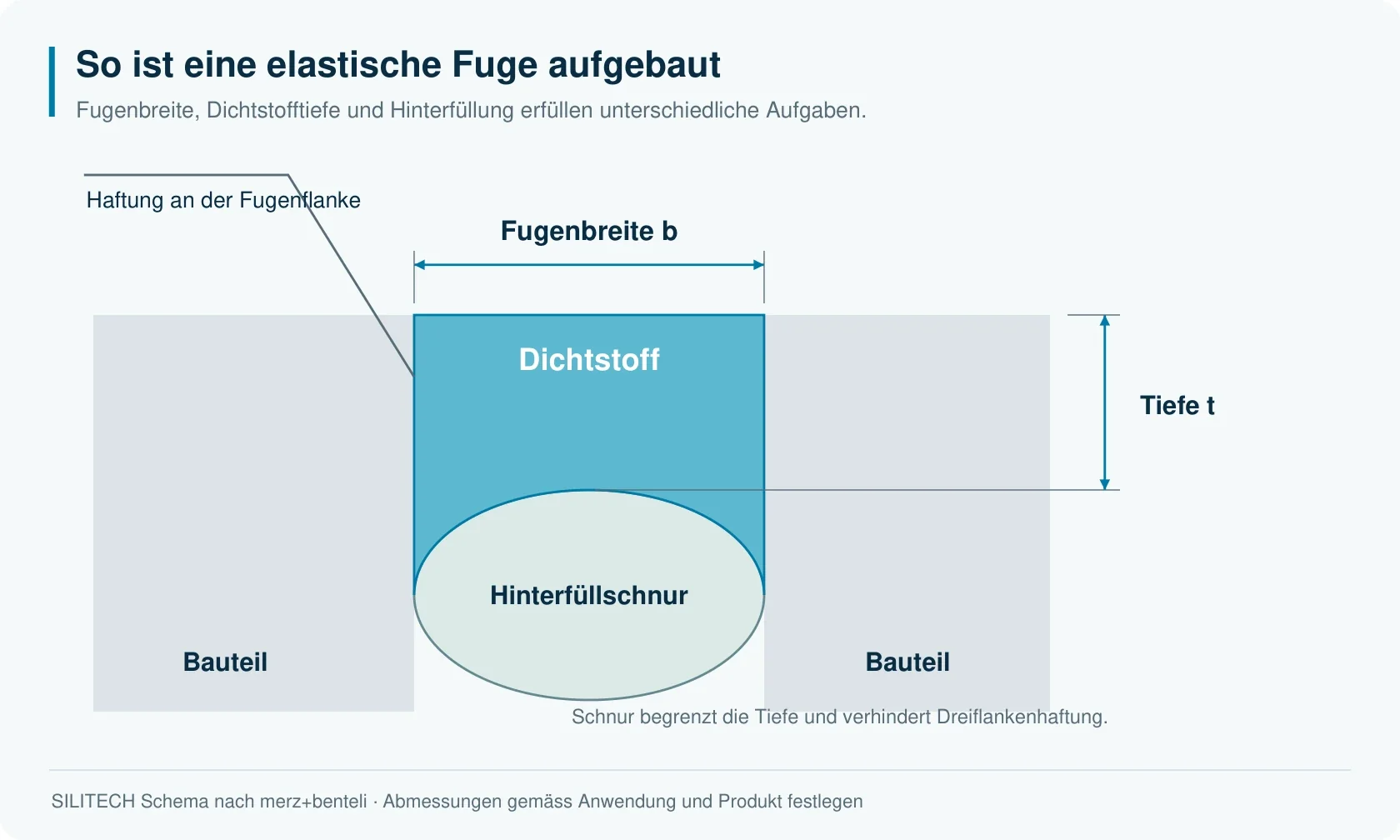
Calculating the sealant requirement
For a rectangular cross-section: width in mm × depth in mm × length in m = volume in ml. For other cross-sections, their actual area must be used.
| calculation | Example |
|---|---|
| Joint compound | 10 mm wide · 8 mm deep · 12 m long |
| Theoretical volume | 10 × 8 × 12 = 960 ml |
| Reserve in the example: 10% | 960 × 1,10 = 1,056 ml |
| Container with 290 ml | 1’056 ÷ 290 = 3,64 → 4 cartridges |
| Container with 310 ml | 1’056 ÷ 310 = 3,41 → 4 cartridges |
| Container with 600 ml | 1’056 ÷ 600 = 1,76 → 2 bags |
Requirements for the sealant
substrate and surface
The sealant must adhere to both sides of the joint. For painted or coated components, adhesion to the coating must be checked.
Movement and stress
Component movement, water, temperature, and mechanical stress determine the requirements for the joint. The necessary joint dimensions must be determined before calculating the required quantities.
Processing and curing
Material and substrate temperature affect processing and curing. The formation of a skin does not necessarily mean that the joint is fully load-bearing.
Paint compatibility
If the joint is to be painted over, the paint and sealant must be compatible. The paint must also be able to accommodate the joint's movement.
Damage to existing joints
| observation | Check for possible causes |
|---|---|
| Sealant is detaching from the side | Cleaning, pretreatment, adhesion and material compatibility. |
| Crack in the sealant or breakout in the substrate | Joint movement, dimensioning and load-bearing capacity of the substrate. |
| Early cracks after execution | Movement during curing and processing climate. |
| Swelling, embrittlement, or discoloration | Chemical stress and compatibility of the materials involved. |
Before the repair, it must be determined which sealant was previously used and why the joint is damaged. The information sheet describes the subsequent steps.
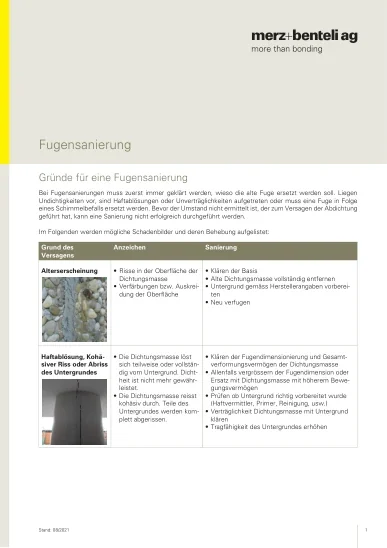
PDF · DE · 6 pages · 08/2021
Joint repair
Damage patterns, surface preparation and execution in an illustrated guide.
Open PDFInformation sheets on processing
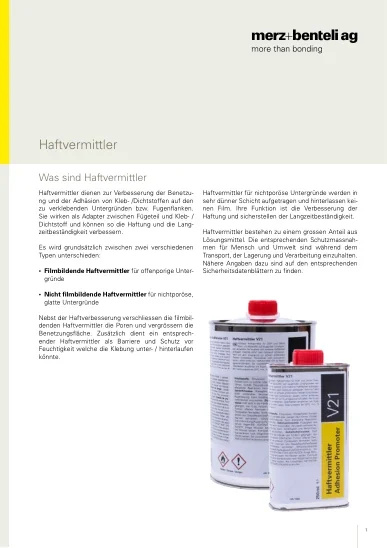
PDF · DE · 4 pages · 07/2019
Adhesion Promoter
Substrates, application types and drying times of the merz+benteli systems.
Open PDF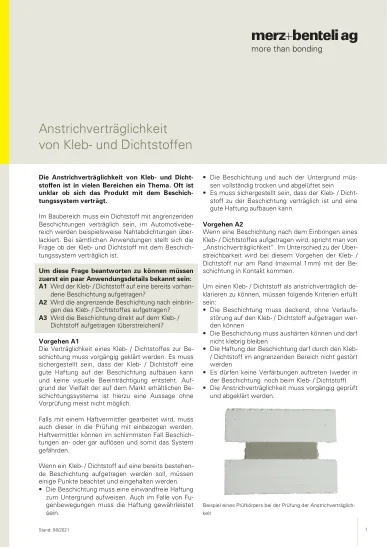
PDF · DE · 6 pages · 08/2021
Paint compatibility
Coating and painting in connection with adhesives and sealants.
Open PDF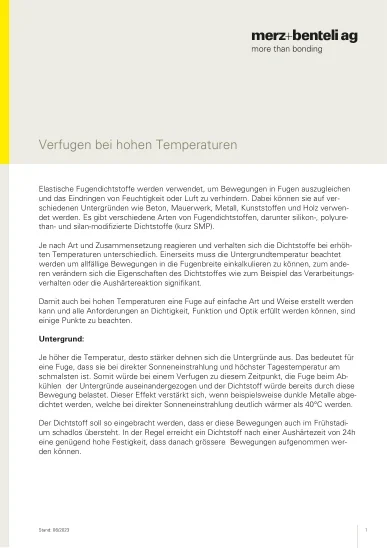
PDF · DE · 3 pages · 06/2023
Grouting at high temperatures
Influence of high temperatures on processing time, curing and joint movement.
Open PDF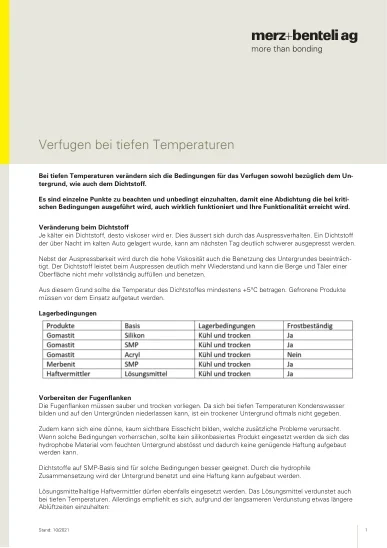
PDF · DE · 5 pages · 10/2021
Grouting at low temperatures
Information regarding condensation, adhesion, and delayed curing in cold conditions. Product-specific information applies only to the sealants listed in the data sheet.
Open PDFMerbenit adhesives and sealants
Our product range overview includes Merbenit products with their properties and areas of application.
Merbenit product range and applications →About the Merz + Benteli brandAdvice on sealant selection
Please specify the materials used, joint dimensions, total length, and operating conditions. For repairs, we also require information on the existing sealant and photos of the damage.
Request a consultation →Further instructions and application notes →
Frequently asked questions
How do you calculate sealant consumption?
For a rectangular cross-section, the following applies: width in millimeters × depth in millimeters × length in meters = milliliters. A joint measuring 10 × 8 mm over 12 m theoretically yields 960 ml. Shaped cross-sections and processing losses must be considered separately.
How many cartridges are needed?
Divide the required volume, including the chosen surcharge, by the contents of one cartridge and round up to the nearest whole container. In the example with 1,056 ml including a 10% reserve, this equates to four cartridges of 290 ml each or four cartridges of 310 ml each.
Why is a backer rod used?
The backer rod limits the depth of the sealant and prevents three-sided adhesion. The sealant should adhere to both sides of the joint. Joint dimensions and backer rod material must be suitable for the application.
Fundamentals and remediation guidelines: merz+benteli, Joint Remediation (08/2021). Calculation example and graphic: SILITECH. Source verification: October 11, 2026.