


 Silicones, silicone oils, sprays
 Casting and potting resins
)
)
Technical Data
Typical values, not a specification. The technical data sheet (TDS) is binding.
Product Information
- Manufacturer
- Permabond Engineering Adhesives Ltd
- Brand
- Permabond
- Container
- 20 g, 50 g, 500 g
- Country of origin
- Italy
Performance at Full Cure
- Impact strength (ASTM D-950)
- 3-5 kJ/m²
- Dielectric strength
- 25 kV/mm
Physical Properties
- Color
- colorless
- Chemical group
- Alkoxyethyl cyanoacrylate
- Viscosity (adhesives)
- Low viscosity <500 MPas
- Viscosity mPa.s
- 90-110
Curing values
- Maximum gap fill (mm)
- 0.08
- PVC hand strength (seconds)
- 5-10
- Hand Strength Phenol (sec.)
- 5-10
- ABS hand strength (sec.)
- 5-10
- Neoprene hand strength (sec.)
- 2-5
- Fixture time on steel (sec.)
- 10-15
- Handling strength of aluminum (sec.)
- 10-15
- Hand strength of zinc (seconds)
- 30-40
- Final strength
- 24 hours
Mechanical properties
- Hardness (Shore D)
- 85
Shear strength ISO 4587 in N/mm²
- Steel
- 16-20
- Aluminum
- 8-9
- Zinc
- 8
- ABS
- >6
- PC
- >5
- Phenol
- 4
Thermal Properties
- Storage Temperature (°C)
- 2-7
- Operating temperature (°C)
- -55 to +80
Product Description
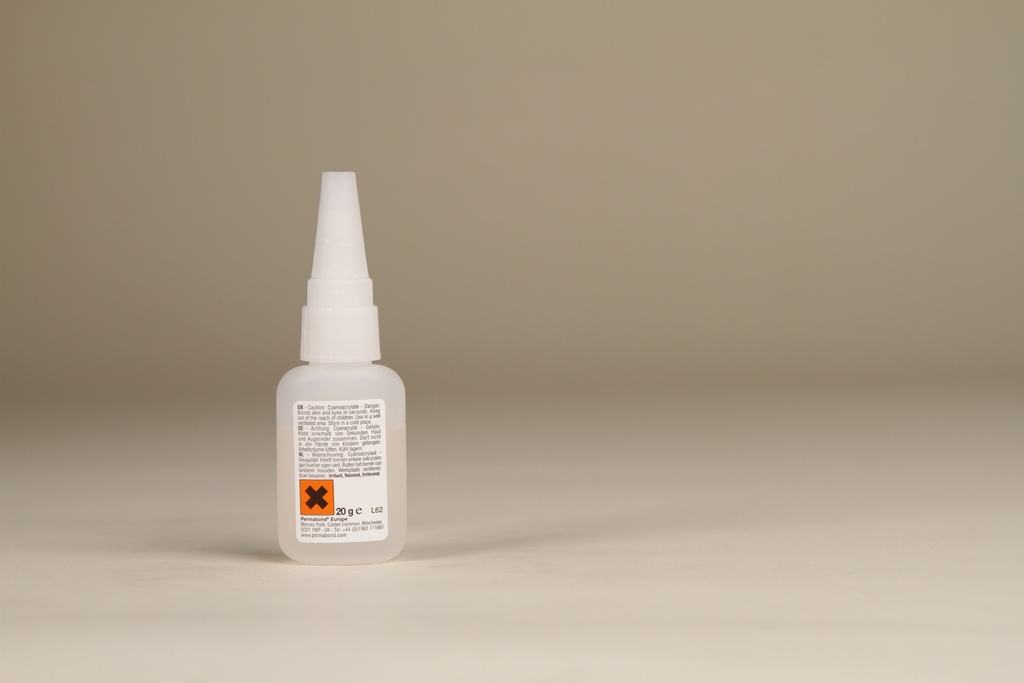
Permabond 943 is the medium viscosity variant of the Low-Bloom range — the standard industrial adhesive for general bonding applications where classic cyanoacrylate behavior is required, combined with an aesthetically clean bond line and reduced odor.
With a viscosity of 90–110 mPa·s, 943 covers the standard range of cyanoacrylate viscosities and fills gaps up to 0.15 mm. On virtually all common substrates—PVC, phenol, ABS—handling strength is 5 to 10 seconds, and on steel, 10 to 15 seconds.
Like all low-bloom variants, 943 prevents the white evaporation pattern and reduces solvent vapors—properties that are commercially valuable in consumer goods, packaging, and electronics manufacturing. On ABS and PC, the break test results in substrate failure.
Low odor and non-blooming — the medium-viscosity variant of the Low-Bloom range. Standard cyanoacrylate geometry (0.15 mm gap width) with alkoxyethyl chemistry for a clean appearance and odor reduction.
What distinguishes Permabond 943
What is Permabond 943 used for?
Processing
Recommended accessories
Important Notes
Which Permabond for which application?
Permabond 943 in direct comparison with related cyanoacrylate products.
Permabond 943 Current Product | Permabond 940 → | Permabond 941 → | Permabond 947 → | |
|---|---|---|---|---|
| Chemistry | Alkoxyethyl cyanoacrylate | Alkoxyethyl-CA | Alkoxyethyl-CA | Alkoxyethyl-CA |
| Viscosity | 90-110 mPa·s | 3–10 mPa·s | 10–20 mPa·s | 900–1,500 mPa·s |
| Max. gap fill. | 0.15 mm | 0.05 mm | 0.08 mm | 0.25 mm |
| Finger-tight on steel | 10–15 s | 10–15 s | 10–15 s | 20–30 s |
| Shear strength steel | 16-20 N/mm² | 16-20 N/mm² | 16-20 N/mm² | 16-20 N/mm² |
| Strength / Recommended for | Low Odor Low-Bloom | Ultra-low, Wicking | Low viscosity | Pasty, vertical/coarse column |
Frequently asked questions about Permabond 943
Practical application and design questions — answered by SILITECH.
Permabond 943 is an alkoxyethyl cyanoacrylate instant adhesive with a viscosity of 90–110 mPa·s and a maximum gap filling of 0.15 mm. This low-odor, non-blooming cyanoacrylate adhesive is medium-viscosity and suitable for general industrial bonding applications with aesthetic requirements.
Permabond 943 reliably bonds steel (16–20 N/mm²), aluminum (8–9 N/mm²), ABS (>6 N/mm² (substrate failure)), polycarbonate (>5 N/mm² (substrate failure)), as well as Buna-N rubber and similar elastomers. For polypropylene (PP), polyethylene (PE), PTFE, and silicone, pretreatment with Permabond Polyolefin Primer (POP) is required.
Low odor and non-blooming — the medium-viscosity variant of the Low-Bloom range. Standard cyanoacrylate geometry (0.15 mm gap width) with alkoxyethyl chemistry for a clean appearance and odor reduction.
Permabond 943 reaches handling strength on steel in 10–15 seconds. Other typical curing times: 2–5 seconds (NBR), 5–10 seconds (PVC/phenol/ABS), 30–40 seconds (zinc). The final strength of 16–20 N/mm² (steel) is reached after 24 hours. Temperature, humidity, and substrate affect the curing rate.
Permabond 943 offers a viscosity of 90–110 mPa·s, a gap filling capacity of 0.15 mm, and a shear strength of 16–20 N/mm² on steel. Permabond 940 has a viscosity of 3–10 mPa·s, a gap filling capacity of 0.05 mm, and a shear strength of 16–20 N/mm² on steel (ultra-low wicking). Both utilize an alkoxyethyl cyanoacrylate base (or a related cyanoacrylate variant).
Permabond 943 should be stored unopened at 2 to 7 °C and is stable until the printed expiration date. Allow the bottle to warm to room temperature before opening—this prevents condensation inside, which would reduce its shelf life. Opened bottles remain functional for several months if stored correctly, although the curing rate may decrease over time. We recommend a test bond to check reactivity before critical production applications.
From the Permabond cyanoacrylate range, select according to viscosity and special properties: Permabond 943 (90–110 mPa·s, 0.15 mm gap width, low odor); Permabond 940 (3–10 mPa·s, 0.05 mm, ultra-low viscosity, wicking); Permabond 941 (10–20 mPa·s, 0.08 mm, low viscosity); Permabond 947 (900–1,500 mPa·s, 0.25 mm, pasty, vertical/coarse gaps). For polypropylene, polyethylene, PTFE, and silicone, pretreatment with Permabond Polyolefin Primer (POP) is always required.