



 Silicones, silicone oils, sprays
 Casting and potting resins

Acrystal is a water-based, two-component system consisting of an acrylic resin liquid and a mineral powder. It is used to create castings, fiber-reinforced components, and coatings on foam cores. The specific system used is crucial for processing and subsequent application: Prima and Aqua differ in composition, mixing ratio, and curing time.
Cover photo: Restaurant Sur Mesure, Mandarin Oriental Paris. Photo Hélène Hilaire; Project source Acrylal.
Acrystal Prima or Aqua
| Acrystal Prima | Acrylic Aqua | |
|---|---|---|
| Components | Prime Liquid + Basic Crystal Powder | Aqua liquid + Aqua powder on a white cement base |
| Mixing Ratio | 1 : 2.5 by weight | 1:7 by weight |
| Application | For indoor use; for outdoor use with a suitable protective coating | Indoor and outdoor use; also suitable for prolonged contact with water |
| Typical processing | Pouring, laminating and applying to suitable foam cores | Pouring, laminating and applying to suitable foam cores |
| Pay attention to the curing process | Demolding depends on the component and processing; refer to the manufacturer's instructions | The manufacturer specifies 24 hours until demolding, at least 72 hours in a humid environment, and 28 days until complete curing |
Basis: Acrystal Prima – Product Data Sheet (DE) and Acrystal Aqua – Product Data Sheet (DE). Time specifications are manufacturer's values; component and processing conditions must be taken into account.
Casting, laminating, or coating a core
Pour
The mixture is poured into a prepared mold. The process is suitable for castings and components whose volume is to consist entirely of Acrystal.
Making silicone moldsLaminate
The mold produces a visible layer and a structure reinforced with fiberglass fabric. This allows for the production of shells and thin-walled components.
View laminate constructioncore coating
A lightweight foam core provides the basic shape. Acrystal forms the surface; fiber reinforcement and connections are designed according to the component.
Examples from model and stage constructionMixing ratios by weight
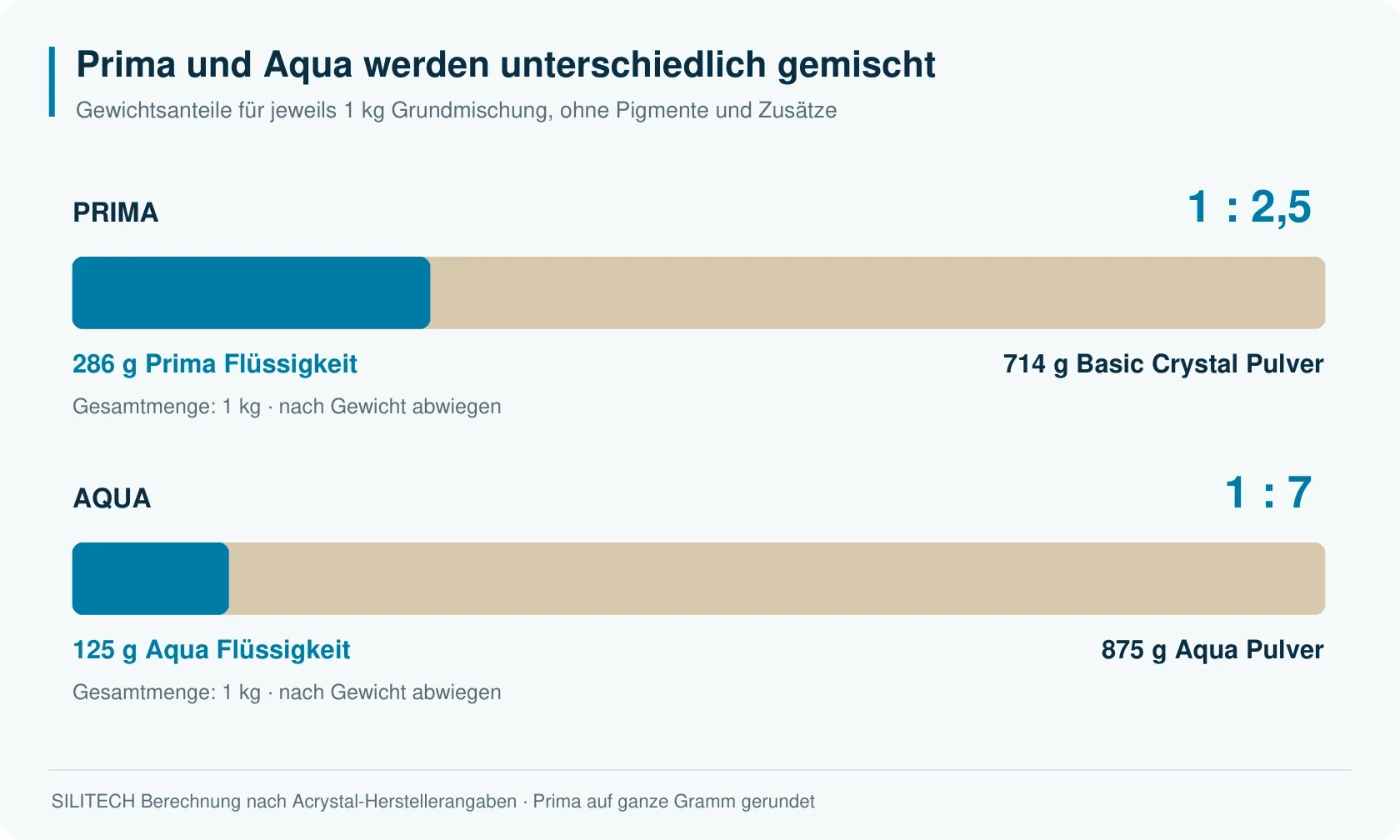
Weigh out the liquid and powder. Use only the components belonging to the system. The ratio for Prima should not be used with Aqua or Decor systems.
| System | Example set | Order of mixing |
|---|---|---|
| Prima | 1 kg liquid + 2.5 kg Basic Crystal = 3.5 kg | Premix the liquid; stir in the powder. |
| Aqua | 1 kg liquid + 7 kg Aqua powder = 8 kg | Briefly pre-mix the water powder; slowly add the liquid to the powder. |
Instructions: Prima instructions (FR) · Aqua instructions (DE).
Laminating with Acrystal Prima
The visible surface is formed first on the mold surface. This is followed by the primer and the fiberglass fabric. The illustration shows the principle; the number of layers, reinforcements, and connections depend on the component.
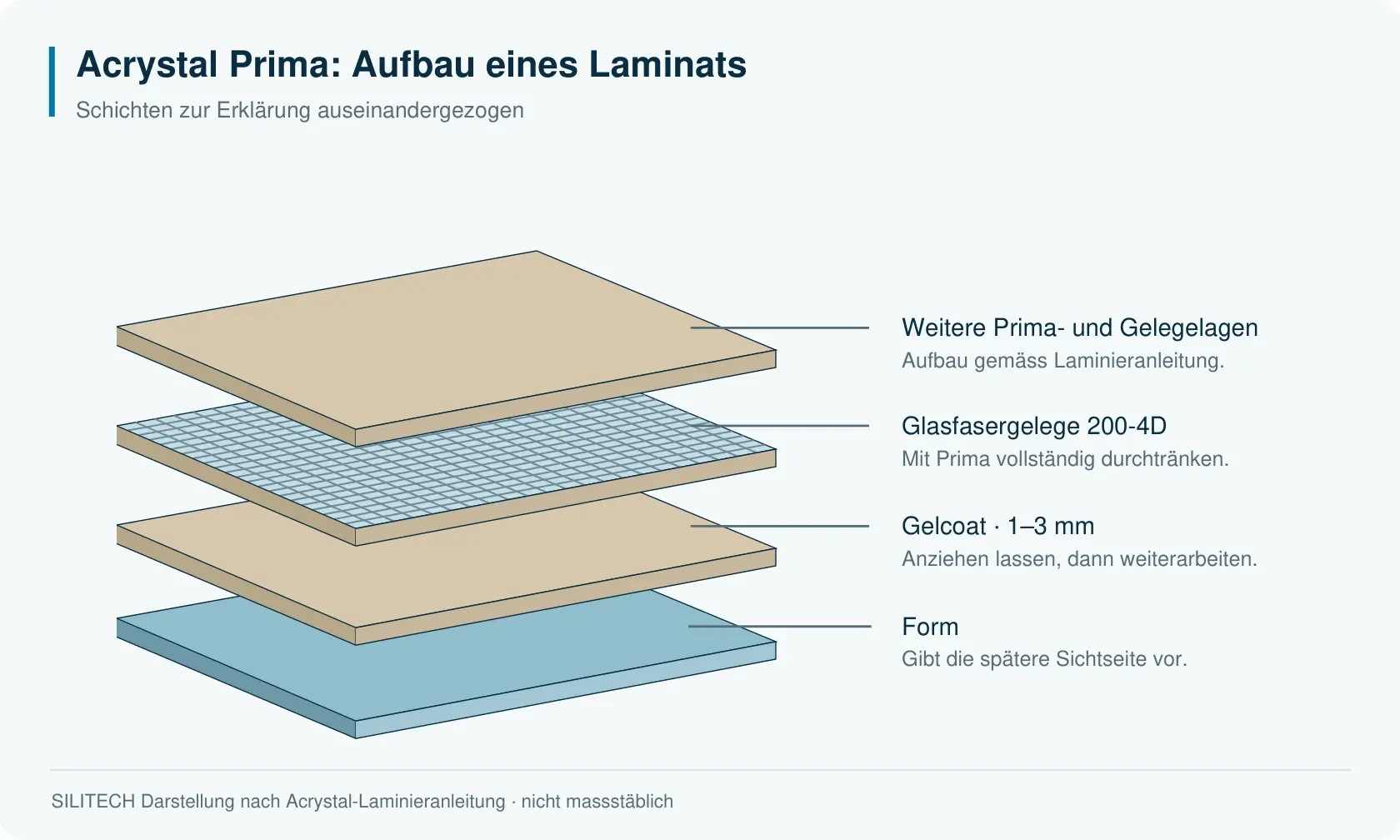
- Prepare the mold and fiberglass mat
. Prepare the mold and cut the fiberglass mat to size. Before mixing, check whether the mold requires a release agent. - Apply the gelcoat.
The laminating instructions specify a layer thickness of 1–3 mm. Allow the layer to set until it is matte and no longer sticks to your finger. - Soak the first layer of eggs.
Apply Prima, place the eggs in the solution, and soak them completely. Work out any trapped air. - To complete the laminate installation
, build up the remaining primer and underlayment layers according to the instructions. Finish with a primer layer. - Demolding and post-processing:
Only demold once the component is sufficiently stable. The instructions indicate approximately 20 minutes to 2 hours, depending on size and complexity; curing and post-processing times depend on the product used.
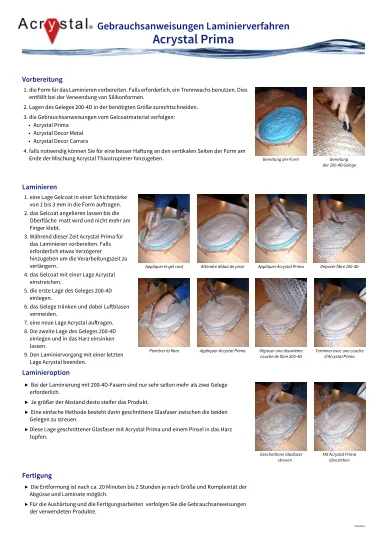
ACRYSTAL · DE · 1 page
Illustrated laminating instructions
The individual work steps with photos: preparing the mold, applying the gelcoat, inserting and soaking the fabric.
Open PDFApplications from Acrystal's references
The following projects demonstrate different construction methods and operating conditions. The execution and photographs were provided by the project participants listed with the manufacturer.
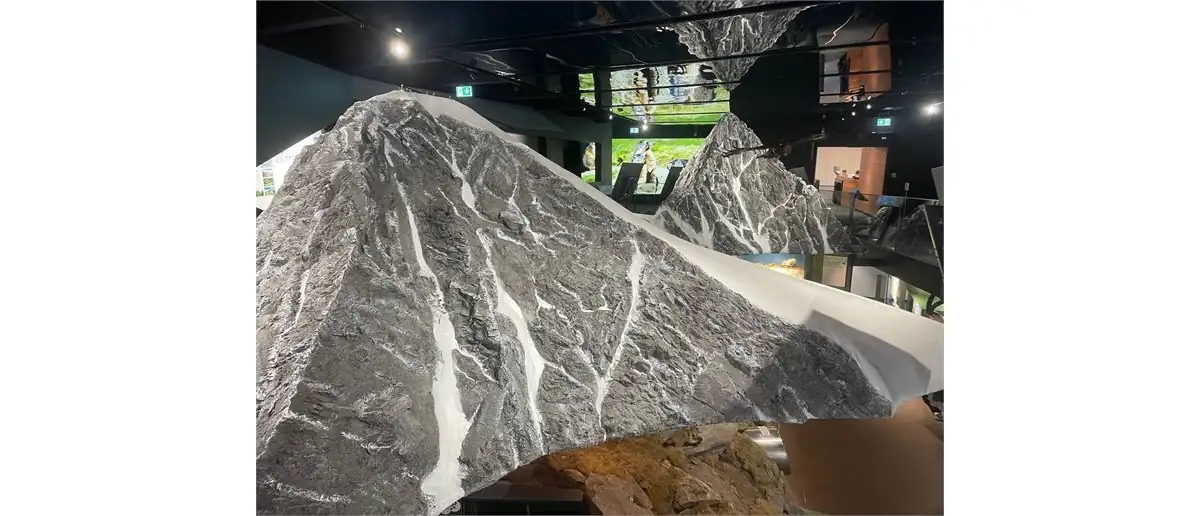

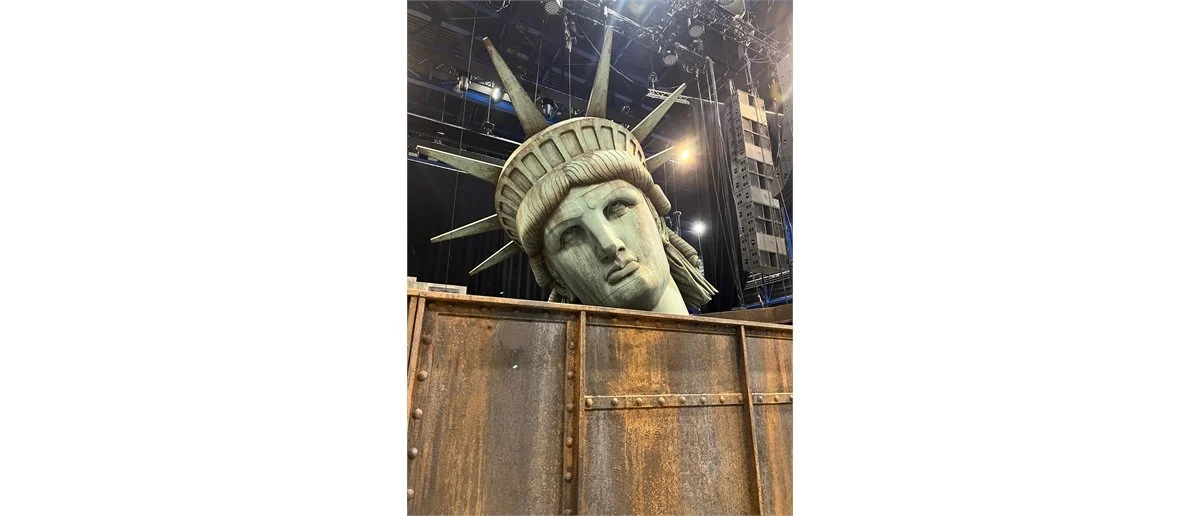
Large volumes do not need to be cast in solid form
For the Soprano Freedom Tour, Artefact produced a head of the Statue of Liberty approximately eight meters high and eight meters wide. According to Acrystal, it consists of a polystyrene core with Prima and 200-4D fiberglass fabric.
This example demonstrates how the shape of a large object with a core can be produced. The coating takes care of the surface design. Fastening, transport, and load-bearing capacity must be planned for each specific object.
Acrystal products at SILITECH
Eggs and additives for Prima
Manufacturer's instructions and product data sheets
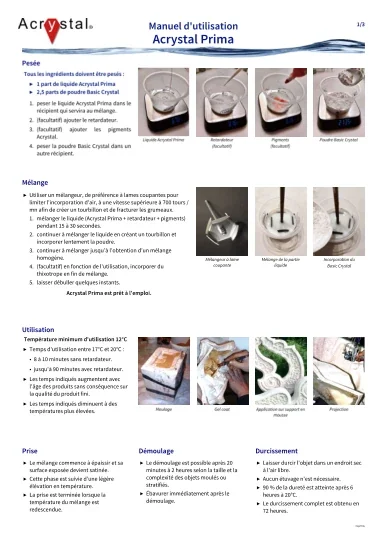
ACRYSTAL · FR · 3 pages
Processing Acrystal Prima
Illustrated instructions for mixing and processing the Prima system.
Open PDF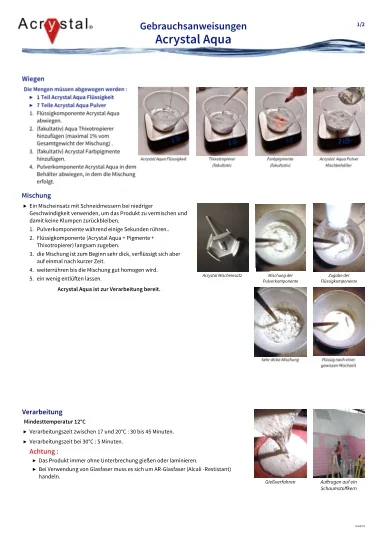
ACRYSTAL · DE · 2 pages
Processing Acrystal Aqua
Instructions for mixing sequence, processing and post-treatment of Aqua.
Open PDF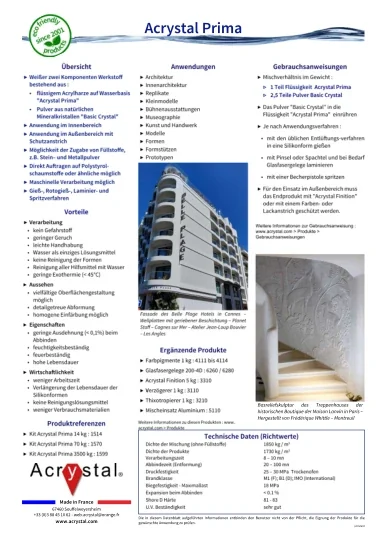
ACRYSTAL · DE · 1 page
Acrystal Prima: Properties and Uses
Components, applications, protective coating for outdoor use and technical guidelines.
Open PDF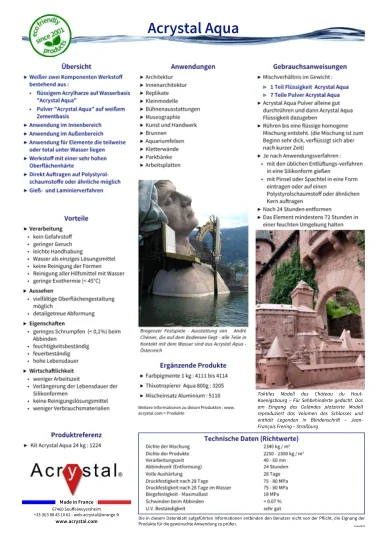
ACRYSTAL · DE · 1 page
Acrystal Aqua: Properties and Uses
Components, water contact, curing and technical guidelines.
Open PDFFrequently asked questions
What is the difference between Acrystalline Prima and Aqua?
Prima is mixed with Basic Crystal powder in a 1:2.5 ratio by weight. Aqua uses its own white cement-based powder and is mixed 1:7. According to the manufacturer, Aqua is intended for prolonged water contact; for Prima, the manufacturer requires a protective coating for outdoor use.
Can Acrystal be applied directly to polystyrene?
The manufacturer lists polystyrene foam and similar foams as possible cores. The suitability of the specific core, the layer configuration, reinforcements, and connections must be appropriate for the object.
Is the mixing ratio determined by volume or weight?
The ratios mentioned here are by weight. The components are weighed. For example, 1 kg of Prima Liquid and 2.5 kg of Basic Crystal Powder together yield 3.5 kg of base mixture.
Is Aqua fully cured after 24 hours?
No. The product data sheet states 24 hours until demolding and 28 days until complete curing. Furthermore, the component should be kept in a humid environment for at least 72 hours.
Advice on material selection
SILITECH supplies Acrystal in Switzerland and will assist you with your selection. Please provide us with the dimensions, quantity, desired surface finish, and intended location. For outdoor applications, it is also important to know if and for how long the object will be in contact with water.
Request an Acrystal application · Acrystal product range
Source verification: October 11, 2026. Technical data from the Acrystal documents linked above. Project descriptions based on manufacturer references. Own diagrams: SILITECH. Further manufacturer instructions and application videos.