


 Silicones, silicone oils, sprays
 Casting and potting resins
)
)
Technical Data
Typical values, not a specification. The technical data sheet (TDS) is binding.
Product Information
- Manufacturer
- Permabond Engineering Adhesives Ltd
- Brand
- Permabond
- Container
- 250 ml, 500 ml, 1 l
- Country of origin
- Italy
Performance at Full Cure
- Thermal conductivity
- 0.19 W/(m.K)
Physical Properties
- Color
- green
- Chemical group
- Methacrylate ester
- Viscosity (adhesives)
- Low viscosity <500 MPas
- Viscosity mPa.s
- 10-20
Curing values
- Maximum gap fill (mm)
- 0.05
- Handling strength (M10 steel)@23°C
- 5-20 seconds
- Functional strength (M10 steel)@23°C
- 20 minutes
- Ultimate strength (M10 steel)@23°C
- 1 hour
Thermal Properties
- Storage Temperature (°C)
- 5-25
- Operating temperature (°C)
- -55 to 150
- Coefficient of thermal expansion
- 90 x 10-6 mm/mm/°C
Product Description
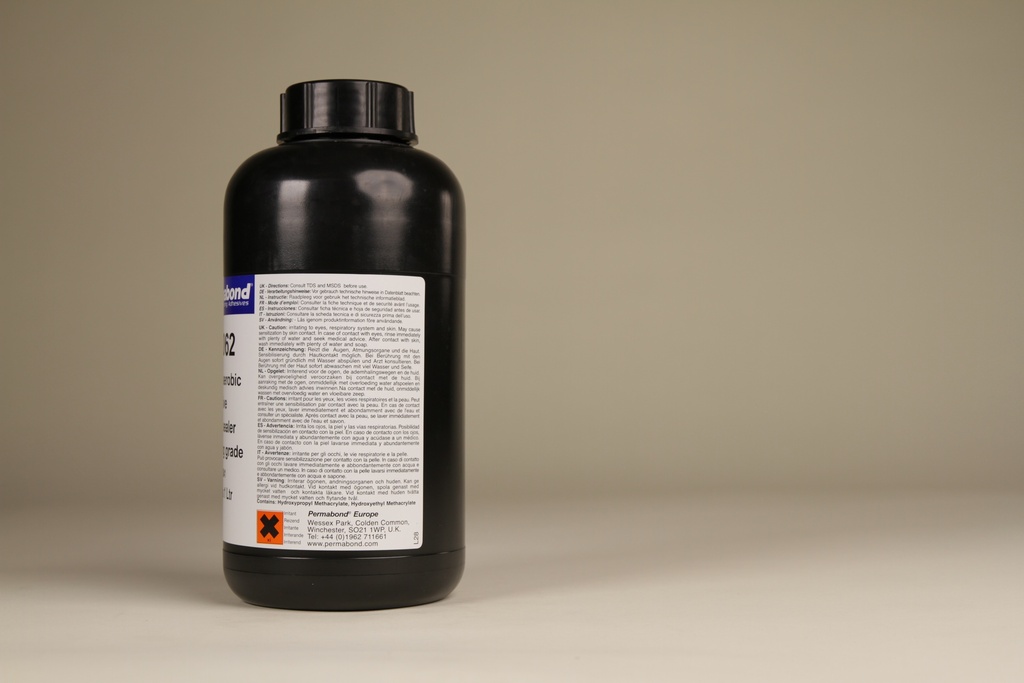
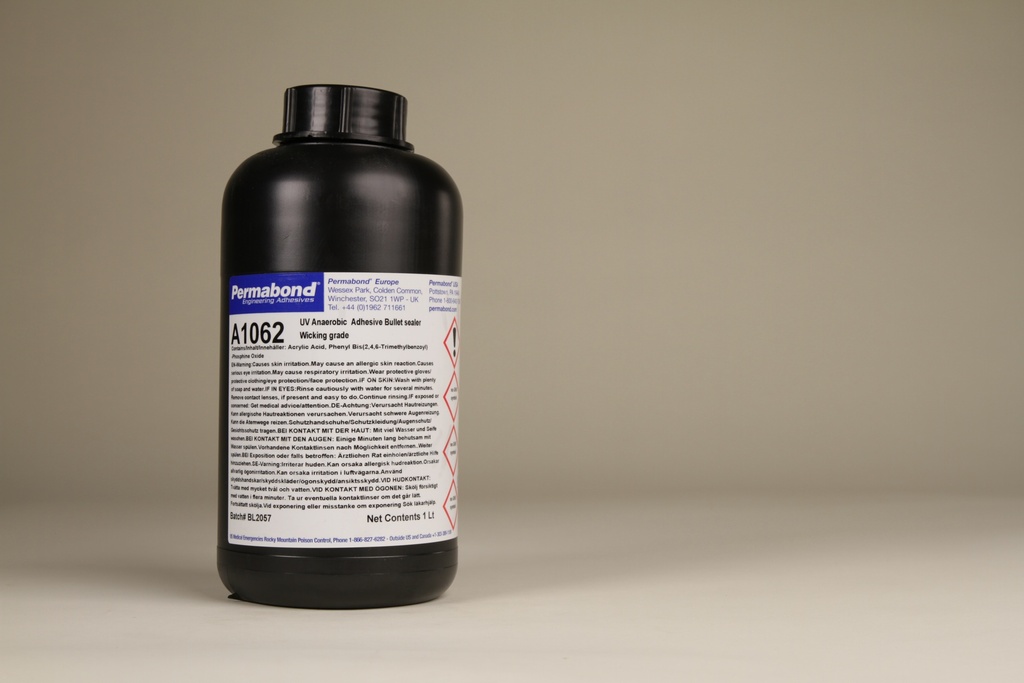
Permabond A1062 is a wicking shaft-hub adhesive with dual curing chemistry—anaerobic in the gap, UV-curing on the surface. Its low viscosity allows for application to already assembled components.
With a viscosity of 10–20 mPa·s, A1062 is ultra-low viscosity and flows through capillary action into micro-gaps down to 0.05 mm — even previously assembled components can be bonded. Anaerobic curing takes place in the gap under anaerobic conditions.
The unique secondary curing process using UV light (365–420 nm spectrum, 5–20 seconds at a 4 mW lamp) cures excess adhesive on the surface—an advantage in ammunition sealing and manufacturing processes with visible adhesive seams. The methacrylate chemistry distinguishes A1062 from the classic acrylic of the Standard A series.
Anaerobic + UV secondary curing — the unique combination of two curing mechanisms: anaerobic in the gap (shaft-hub), UV light for excess adhesive on the surface (5–20 seconds at 365–420 nm). Low viscosity for wicking penetration.
What distinguishes Permabond A1062
What is Permabond A1062 used for?
Processing
Recommended accessories
Important Notes
Which Permabond anaerobic adhesive for which application?
Permabond A1062 in direct comparison with related products of the A series.
Permabond A1062 Current Product | Permabond HM162 → | Permabond A1046 → | Permabond A126 → | |
|---|---|---|---|---|
| Application / Strength | Shaft-hub wicking + UV secondary curing | Higher viscosity, apply before assembly | High strength without UV secondary curing | Wicking without UV secondary curing |
| Viscosity | 10-20 mPa·s | 1,000 mPa·s | — | 10–30 mPa·s |
| Max. gap fill. | 0.05 mm | 0.12 mm | 0.25 mm | 0.05 mm |
| Breakaway Torque | — | 32 N·m | 30 N·m | 14 N·m |
| Prevailing torque | — | 57 N·m | 50 N·m | 34 N·m |
Frequently asked questions about Permabond A1062
Practical application and design questions — answered by SILITECH.
Permabond A1062 is a methacrylate (anaerobic with UV secondary curing) with a viscosity of 10–20 mPa·s and gap filling capability up to 0.05 mm. It is a wicking shaft-hub adhesive with UV secondary curing—penetrating into assembled components and UV curing of excess. Anaerobic adhesives cure in the absence of air and in contact with metal—ideal for tight-tolerance metallic bonds.
Anaerobic adhesives like Permabond A1062 remain liquid in the bottle (due to contact with air and oxygen) and only begin to harden after bonding under anaerobic conditions and metal-to-metal contact. Curing starts at the metal surface and progresses into the bond gap. The product cures quickly on steel and copper; on stainless steel and zinc, the Permabond A905 activator may be beneficial.
Difficult to separate — shaft-hub adhesives are designed for permanent bonds. Disassembly typically requires heating the joint above 200 °C, after which the bond can be mechanically separated.
Permabond A1062 does not have specific industry approvals such as WRAS or KTW (drinking water). For general industrial applications, the product is approved according to Permabond's internal specifications; however, product-specific testing prior to series production is recommended.
Permabond A1062 typically reaches handling strength after 15 minutes and functional strength after 1 hour at 23 °C on M10 steel. Final strength is reached after 24 hours. On inactive surfaces (stainless steel, zinc) or at low temperatures, the curing time is extended—Permabond A905 activator accelerates the process.
Permabond A1062 is a shaft-hub wicking bond with UV secondary curing (10–20 mPa·s viscosity, 0.05 mm gap filling, breakaway torque). Permabond HM162 is a high-strength shaft-hub bond (1,000 mPa·s, 0.2 mm gap filling, 32 N·m breakaway torque) – higher viscosity, apply before assembly. Both belong to the anaerobic Permabond A series.
The choice depends on the application: Permabond A1062 (shaft-hub wicking + UV secondary curing); Permabond HM162 (shaft-hub high strength); Permabond A1046 (high strength fast curing); Permabond A126 (universal wicking). For inactive surfaces (stainless steel, zinc, aluminum), Permabond A905 activator be used to accelerate curing.